
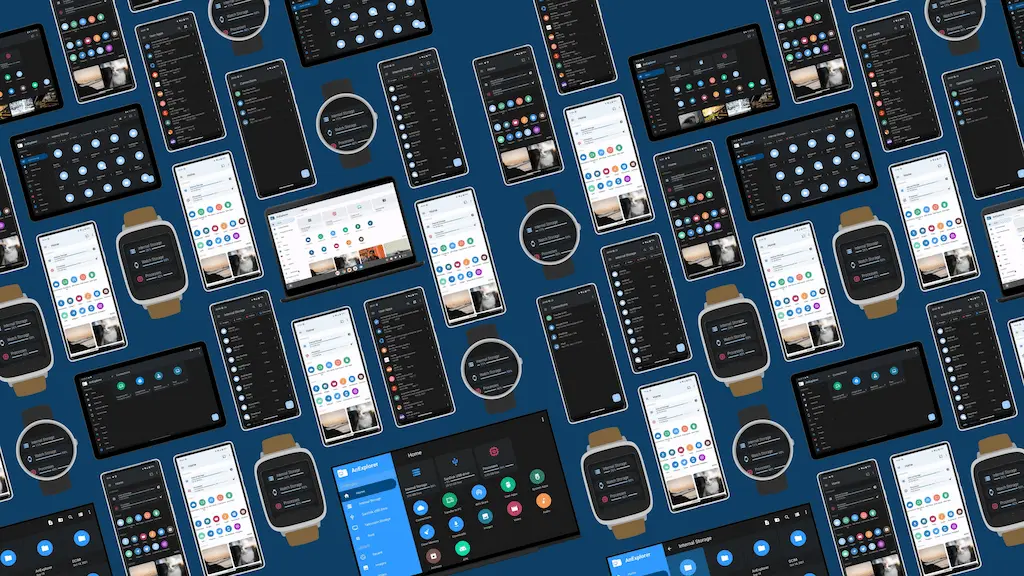
File Manager for BlueStacks
Yes, AnExplorer works well in BlueStacks, and for most users it is the simplest way to run the app on a computer. Available on Windows, macOS, and Linux, BlueStacks offers the easiest entry point. Install AnExplorer from Google Play inside BlueStacks, then use shared folders, drag and drop, keyboard and mouse input, and windowed mode to manage downloads, open archives, connect to SMB shares, or move files through Device Connect without touching a phone.
Why BlueStacks is the mainstream choice
BlueStacks is popular because it removes most of the setup friction that comes with Android environments, and it works across Windows, macOS, and Linux. You do not need to maintain a Linux container, and you do not need an old Windows Subsystem for Android install to get started. Once BlueStacks is installed, AnExplorer behaves like a normal Android app in a desktop window, which makes it a good fit for casual browsing, home-office transfer tasks, and lightweight file cleanup.
If your goal is simply “I want AnExplorer on my PC today,” BlueStacks is the best first stop in the computer family overview.
Compatibility and requirements
BlueStacks works across Windows, macOS, and Linux. It is a practical fit when you want:
- Play Store access for a straightforward install
- keyboard and mouse input instead of touch-only interaction
- windowed mode for side-by-side work with a browser or file explorer
- quick import and export between your computer's folders and the Android environment
On Linux, if you want deeper filesystem integration or a lighter container-based approach, the WayDroid guide is the better read.
How to install AnExplorer in BlueStacks
Option 1: Play Store install
- Install and open BlueStacks on your Windows PC.
- Sign in to Google Play inside BlueStacks.
- Search for AnExplorer and install it normally.
- Launch AnExplorer from the BlueStacks home screen.
Option 2: APK install
- Download the APK from Download.
- Open BlueStacks.
- Use the APK install option or drag the APK into the BlueStacks window.
- Launch AnExplorer once installation completes.
The Play Store route is easier for updates. The APK route is useful when you want to test a direct build or if Play access is unavailable.
Shared folders, drag and drop, and file workflows
This is where BlueStacks is most useful for AnExplorer. You are not trying to manage your host OS itself. You are using the Android app to work with files that move in and out of the Android environment.
Common patterns include:
- dragging a ZIP, APK, PDF, or media file from your computer into BlueStacks so AnExplorer can open it
- exporting screenshots, documents, or downloaded files from the Android side back to your host system
- keeping a shared folder for projects you move between a browser, an editor, and AnExplorer
That makes BlueStacks a convenient test bench for archive management, APK installation, and browser-based Device Connect sessions.
What AnExplorer enables inside BlueStacks
Once it is installed, the app still gives you the same Android features you expect elsewhere:
- browse local Android folders inside the BlueStacks instance
- open ZIP, RAR, and other archive formats
- connect to SMB or NAS storage on your local network
- sign in to supported services from the cloud storage guides
- transfer files from your phone to your PC workflow using Android to PC
That mix is why BlueStacks works well for home users who occasionally need an Android file manager on a large screen.
Keyboard, mouse, and windowed mode
BlueStacks is especially good when you want desktop-style input. Keyboard selection, mouse scrolling, right-click habits, and side-by-side windows make AnExplorer easier to use than on a phone for repetitive browsing tasks. Windowed mode is also helpful when you want to compare a Windows folder with an Android folder or keep a transfer page such as Android to PC open while you work.
This is one of the clearest distinctions between BlueStacks and a handheld Android device: casual file management becomes much more comfortable with a real desktop pointer.
Good use cases for casual computer file management
BlueStacks is a good fit when you want to:
- review Android downloads on a bigger screen
- import a folder from your computer, then reorganize it with Android app workflows
- test WiFi transfer and Device Connect from a desktop browser
- connect to a NAS, pick out files, and move them into a shared host folder
- use AnExplorer without setting up a more advanced Linux or container environment
It is not the best answer for power users who want the host OS and the Android app to feel like one filesystem. For that, read WayDroid.
Known limitations and caveats
BlueStacks is still an emulator-style environment, so not every host file interaction feels native. Shared folder behavior can vary by version, and if you want direct system-level integration with Linux folders, external drives, or Deck-specific controls, another route may be better. It also does not change the fact that AnExplorer is an Android app, not a native file manager for your host OS.
If you want to run AnExplorer on your computer with the least setup friction, BlueStacks is the recommendation across Windows, macOS, and Linux. If you still have WSA, that route can work for legacy Windows 11 installs, but it is no longer the long-term option to start with.