
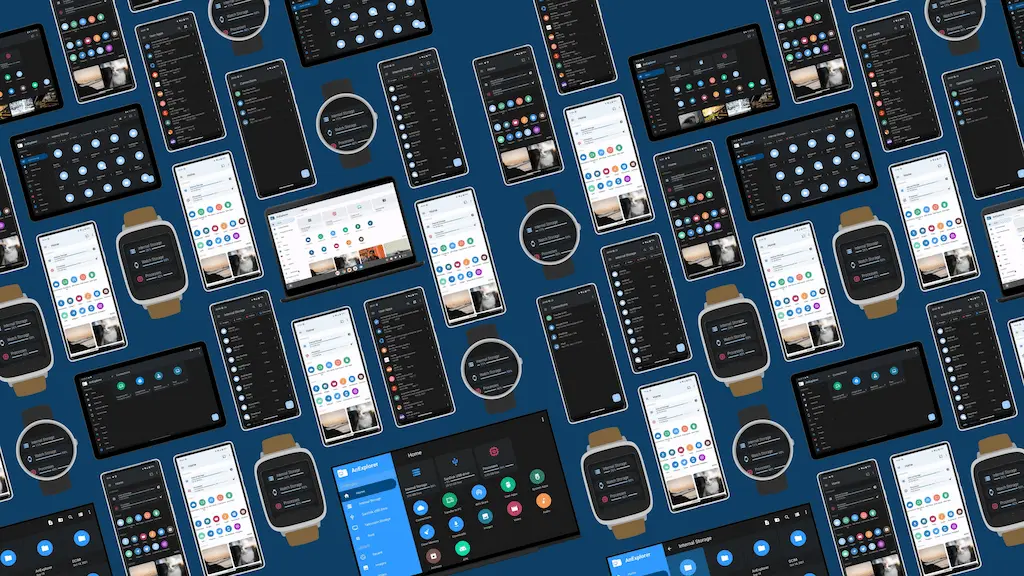
File Manager for Windows Subsystem for Android
Yes, AnExplorer works in Windows Subsystem for Android if you already have WSA installed, but it is now a legacy path. Microsoft ended new Microsoft Store availability for WSA and the Amazon Appstore on 5 March 2025, so this page is for existing Windows 11 setups, testing, and carry-forward installs. If you need a fresh Windows solution, start with BlueStacks instead.
What AnExplorer adds in WSA
WSA was useful because Android apps could live in real Windows 11 app windows rather than in a heavy game-emulator shell. That makes AnExplorer more comfortable for desktop multitasking than many older Windows Android options.
| Capability | Basic WSA app experience | AnExplorer in WSA |
|---|---|---|
| Resizable Android window | ✅ | ✅ plus file-management focused UI |
| Keyboard and mouse use | ✅ | ✅ practical for daily browsing |
| Archive handling | Depends on installed app | ✅ ZIP, RAR, 7z, TAR support |
| SMB / NAS access | Depends on installed app | ✅ Built in |
| Browser-based transfer workflow | Not automatic | ✅ Device Connect support |
If you already have WSA, AnExplorer is one of the more useful productivity-style Android apps to keep there because it benefits directly from snapped windows, pointer input, and desktop multitasking.
When WSA still makes sense
WSA is still useful when you already rely on it for Android app testing or when your Windows 11 machine has an existing working setup you do not want to replace yet. It remains attractive for desktop-style Android use because Windows 11 window snapping, keyboard input, mouse support, and multi-window behavior all fit AnExplorer naturally.
If your goal is validation, QA, or keeping a familiar existing workflow alive, WSA still has value. If your goal is “what should I install today,” use BlueStacks.
Get AnExplorer for Windows Subsystem for Android
Manage, transfer, and access your files on any device.
Compatibility and setup reality in 2026
The key fact to keep straight is this: WSA is not a growth path anymore. Microsoft still documents it in previous-versions content, but new users cannot depend on the old Microsoft Store flow. That means this page should be read as a support and continuity guide, not a primary recommendation from the computer family overview.
If your system already has WSA, AnExplorer can still be practical for:
- large-screen Android file browsing
- SMB and NAS access
- archive handling and APK inspection
- keyboard and mouse testing
- browser-based Device Connect sessions on the same PC
The important distinction is that this remains a support path, not a recommended fresh install path.
Get AnExplorer for Windows Subsystem for Android
Manage, transfer, and access your files on any device.
How to install AnExplorer in an existing WSA setup
Option 1: existing store-based app environment
If your WSA setup already includes its original app distribution path, install AnExplorer there and launch it like any other Android app.
Option 2: APK sideload with ADB
- Open the WSA settings app.
- Enable developer mode.
- Connect with ADB to the local WSA instance.
- Download the APK from Download.
- Install it with
adb install.
This is the most realistic route for ongoing use in 2026.
Why WSA used to be appealing
WSA fit Windows well because Android apps could run in proper resizable windows, use keyboard and mouse input, and participate in normal desktop multitasking. That makes AnExplorer feel more natural here than on many emulator-heavy setups. You can snap it beside a browser, a documentation tab, or a Windows folder while using Android to PC transfer, SMB guides, or cloud storage setup.
For file management, that means a more desktop-native feeling around the Android app even though the app itself is still Android.
It also made WSA attractive for testing because the environment exposed the kinds of input and resizing behavior that matter on larger screens. That is still relevant if your WSA install already works and you want a regression or QA target.
Get AnExplorer for Windows Subsystem for Android
Manage, transfer, and access your files on any device.
File transfer and storage workflows
Inside WSA, AnExplorer is useful for the same Android-oriented tasks it handles elsewhere:
- connecting to NAS and shared folders over SMB
- opening archives and documents in an Android environment
- receiving files through Device Connect or other browser-based flows
- checking how Android app storage behaves on a desktop screen
WSA also supported Windows integration for file and protocol handoff in certain flows, which made it a useful testing target for desktop-oriented Android behavior.
Known limitations and when to move on
The limitation is not mainly AnExplorer. It is the platform lifecycle. WSA is no longer the right recommendation for new users, and any workflow built on it should be treated as legacy-friendly rather than future-proof. If you are starting from zero on Windows, use BlueStacks. If you want a Linux path instead, use WayDroid. Keep WSA for existing systems, regression testing, or users who already have it working and do not need to rebuild the environment.
If your priority is long-term personal use, migrate your expectations toward BlueStacks or another still-supported computer Android environment. If your priority is maintaining an existing desktop Android setup, WSA can still do the job.
Get AnExplorer for Windows Subsystem for Android
Manage, transfer, and access your files on any device.