
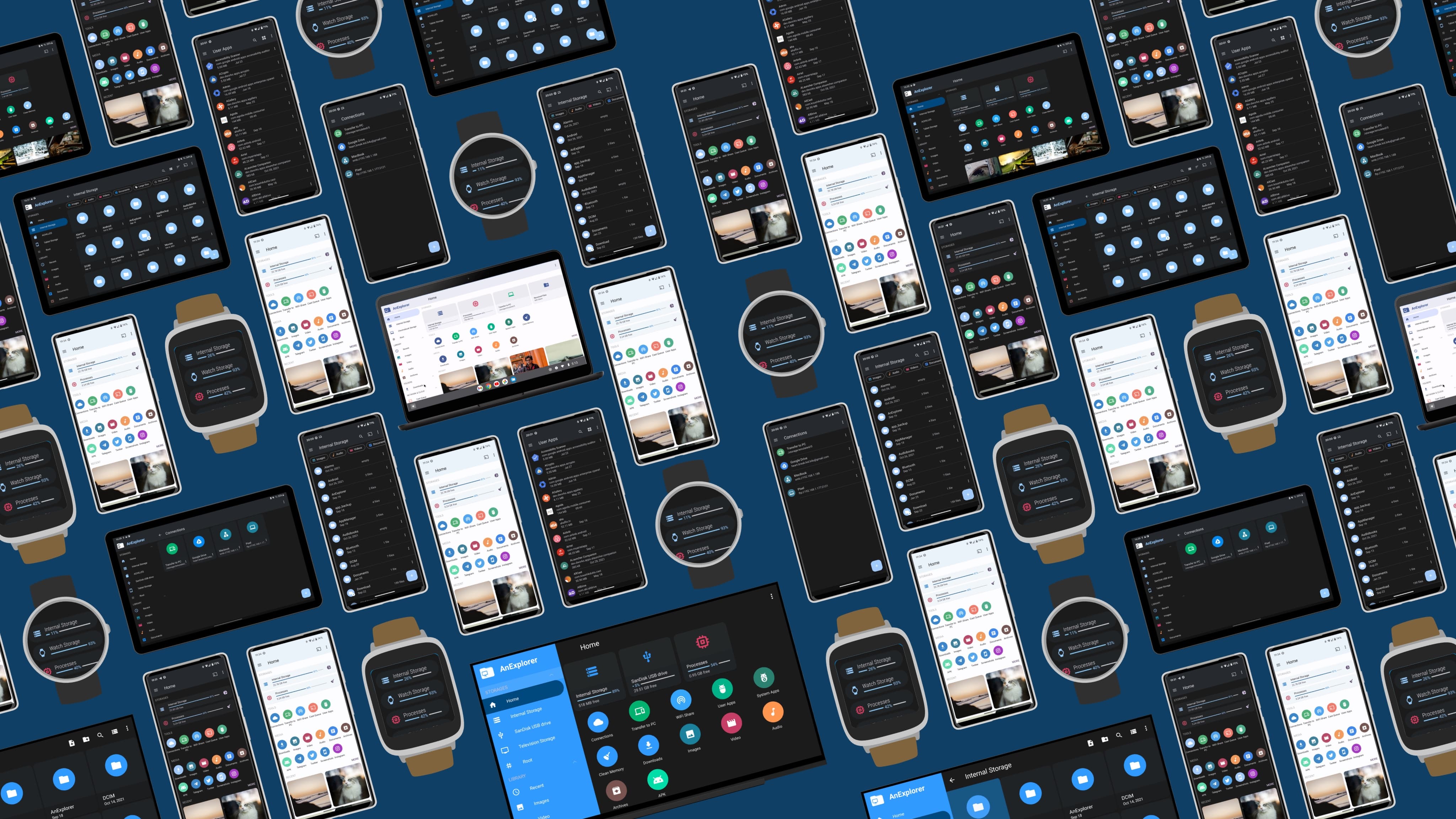
AnExplorer vs LocalSend — Different Tools for Different Jobs
LocalSend has become the darling of the open-source community in 2025-2026 — a clean, simple, no-account file transfer app that works across Android, iOS, Windows, Mac, and Linux. It's genuinely excellent at what it does.
But LocalSend and AnExplorer aren't really competitors — they solve different problems. LocalSend is a transfer tool (send files between devices). AnExplorer is a file manager (manage, browse, transfer, archive, connect to NAS/cloud) that happens to include powerful transfer capabilities.
This comparison helps you understand when each tool is the right choice.
Feature Comparison
| Feature | AnExplorer | LocalSend |
|---|---|---|
| Primary purpose | File management + transfer | File transfer only |
| Transfer method | Device Connect (HTTP server) + Wi-Fi Share | Custom encrypted protocol |
| App needed on other device? | No (browser only for Device Connect) | Yes (LocalSend on both) |
| Transfer speed | 20-50 MB/s (Wi-Fi) | 20-50 MB/s (Wi-Fi) |
| Works offline (no internet) | Yes (local Wi-Fi) | Yes (local Wi-Fi) |
| Encryption | HTTPS mode available | Always encrypted (TLS) |
| Cross-platform | Android only (but browser on any OS) | Android, iOS, Windows, Mac, Linux |
| NAS/SMB/FTP access | ✅ Full client | ❌ Not a file manager |
| Cloud storage | ✅ 7 services native | ❌ Not a file manager |
| Archive management | ✅ ZIP, RAR, 7z, etc. | ❌ Not a file manager |
| Built-in media players | ✅ Video, audio, image, PDF | ❌ Not a file manager |
| Android TV app | ✅ Native TV interface | ❌ No TV app |
| Wear OS app | ✅ Watch app | ❌ No watch app |
| Open-source | No (proprietary) | Yes (MIT license) |
| Price | Free (ads) / $29.99 Pro | Free (no ads) |
| Account required | No | No |
When LocalSend Is the Better Choice
LocalSend wins in specific scenarios:
Phone-to-phone sharing between friends. If both people have LocalSend installed, sharing is instant — tap send, the other person accepts. No address to type, no server to start. The discovery is automatic.
iOS ↔ Android transfers. LocalSend works on iPhone. AnExplorer is Android-only. If you regularly share files with iPhone users, LocalSend bridges the gap.
Privacy-first users. LocalSend is open-source, auditable, and always encrypted. For users who won't trust proprietary software with their files, LocalSend is the transparent choice.
Multi-platform desktop use. LocalSend has native apps for Windows, Mac, and Linux. If you want the same app on every device (not just a browser interface), LocalSend provides that consistency. The desktop apps feel native on each platform — proper system tray integration, drag-and-drop from Finder/Explorer, and automatic device discovery.
Sharing with non-technical people. LocalSend's interface is dead simple — open the app, see nearby devices, tap to send. There's no address to type, no server to start, no concept of "client" vs "server." For sharing with family members who aren't tech-savvy, LocalSend's simplicity wins.
When AnExplorer Is the Better Choice
AnExplorer wins when your needs go beyond simple device-to-device transfer:
The other device doesn't have LocalSend. This is the most common real-world scenario. You're at a friend's house, a hotel business center, or a colleague's desk — they don't have LocalSend installed. AnExplorer's Device Connect works in their browser immediately. No "can you install this app first?" conversation.
You need to access NAS or PC files. LocalSend can't browse your NAS, connect to SMB shares, or access FTP servers. AnExplorer connects to all of these — browse, copy, stream media, manage files on remote storage.
You manage files across multiple device types. AnExplorer works on Android TV (with remote control), Wear OS (watch app), VR headsets, and Chromebook. LocalSend is phone/tablet/desktop only.
You need more than transfer. Archive extraction (ZIP, RAR, 7z), PDF viewing, media playback, storage analysis, app management, cloud storage access — AnExplorer is a complete file management solution. LocalSend does one thing (transfer) and does it well, but that's all it does.
You transfer to the same PC regularly. AnExplorer's SMB client connects to a Windows shared folder — once set up, it's always available without starting anything. LocalSend requires both apps to be open each time.
You're on Android TV or Wear OS. AnExplorer has dedicated apps for TV (with D-pad navigation) and Wear OS (watch file management). If you need to transfer files to your TV or watch, AnExplorer handles it natively. LocalSend has no TV or watch app — you'd need to sideload it and navigate with a phone-oriented interface.
You work with archives. Need to extract a ZIP, open a RAR, or create a 7z archive? AnExplorer handles it. LocalSend can transfer the archive file but can't do anything with its contents.
You want a single app for everything. Instead of having LocalSend for transfer, a separate file manager for browsing, a separate cloud app for each service, and a separate archive tool — AnExplorer consolidates all of these into one app. Fewer apps installed, less storage used, one interface to learn.
The "Use Both" Approach
Many power users run both:
- LocalSend for quick phone-to-phone sharing with friends who also have it (the "AirDrop replacement" use case)
- AnExplorer for everything else — NAS access, cloud management, PC transfers via browser, file management, archive handling, media playback
They don't conflict. Both can be installed simultaneously. Use whichever fits the specific situation.
Transfer Speed Comparison
Both tools achieve similar speeds because they're both limited by your Wi-Fi network, not by the protocol:
| Network | AnExplorer Device Connect | LocalSend | Bottleneck |
|---|---|---|---|
| 5 GHz Wi-Fi (same room) | 30-50 MB/s | 30-50 MB/s | Wi-Fi bandwidth |
| 5 GHz Wi-Fi (through walls) | 15-25 MB/s | 15-25 MB/s | Signal strength |
| 2.4 GHz Wi-Fi | 8-15 MB/s | 8-15 MB/s | Channel congestion |
The protocol overhead difference (HTTP vs LocalSend's custom protocol) is negligible compared to the Wi-Fi bandwidth limit. Both saturate the available network equally.
Security Comparison
LocalSend: Always encrypted with TLS. Uses certificate pinning. Open-source code is auditable. No data leaves your local network.
AnExplorer Device Connect (HTTP mode): Unencrypted by default (plain HTTP on local network). HTTPS mode available for encrypted transfers. Data stays on local network. Not open-source.
AnExplorer Device Connect (HTTPS mode): Encrypted. Comparable security to LocalSend for local transfers.
For sensitive files: Use LocalSend (always encrypted) or AnExplorer in HTTPS mode. For casual transfers on your home network (photos, videos, documents), the encryption difference is academic — both keep data on your local network.
Real-World Scenarios: Which Tool Fits?
"I want to send photos to my friend's phone right now" → If they have LocalSend: use LocalSend (instant discovery, tap to send) → If they don't: use AnExplorer Device Connect (they open a browser, you share the address)
"I want to move files from my PC to my phone every day" → AnExplorer with SMB (set up once, always available) or Device Connect (start when needed) → LocalSend works too but requires opening the app on both sides each time
"I want to access my NAS movie library from my phone" → AnExplorer (SMB client, streams video directly) → LocalSend can't do this — it's not a file browser
"I want to send a file from my iPhone to my Android" → LocalSend (works on both iOS and Android) → AnExplorer can't run on iPhone — use Device Connect only if the iPhone has a browser open to your Android's address
"I want to transfer files to my Android TV" → AnExplorer (native TV app with Wi-Fi Share) → LocalSend has no TV app
"I care deeply about open-source and privacy" → LocalSend (MIT license, fully auditable, always encrypted) → AnExplorer is proprietary — if open-source is a hard requirement, LocalSend wins this category
Related Guides
- Transfer Android to PC — full PC transfer guide using Device Connect
- Transfer PC to Android — reverse direction
- AnExplorer vs Files by Google — comparison with Android's default
- Wi-Fi Transfer feature — AnExplorer's device-to-device sharing