
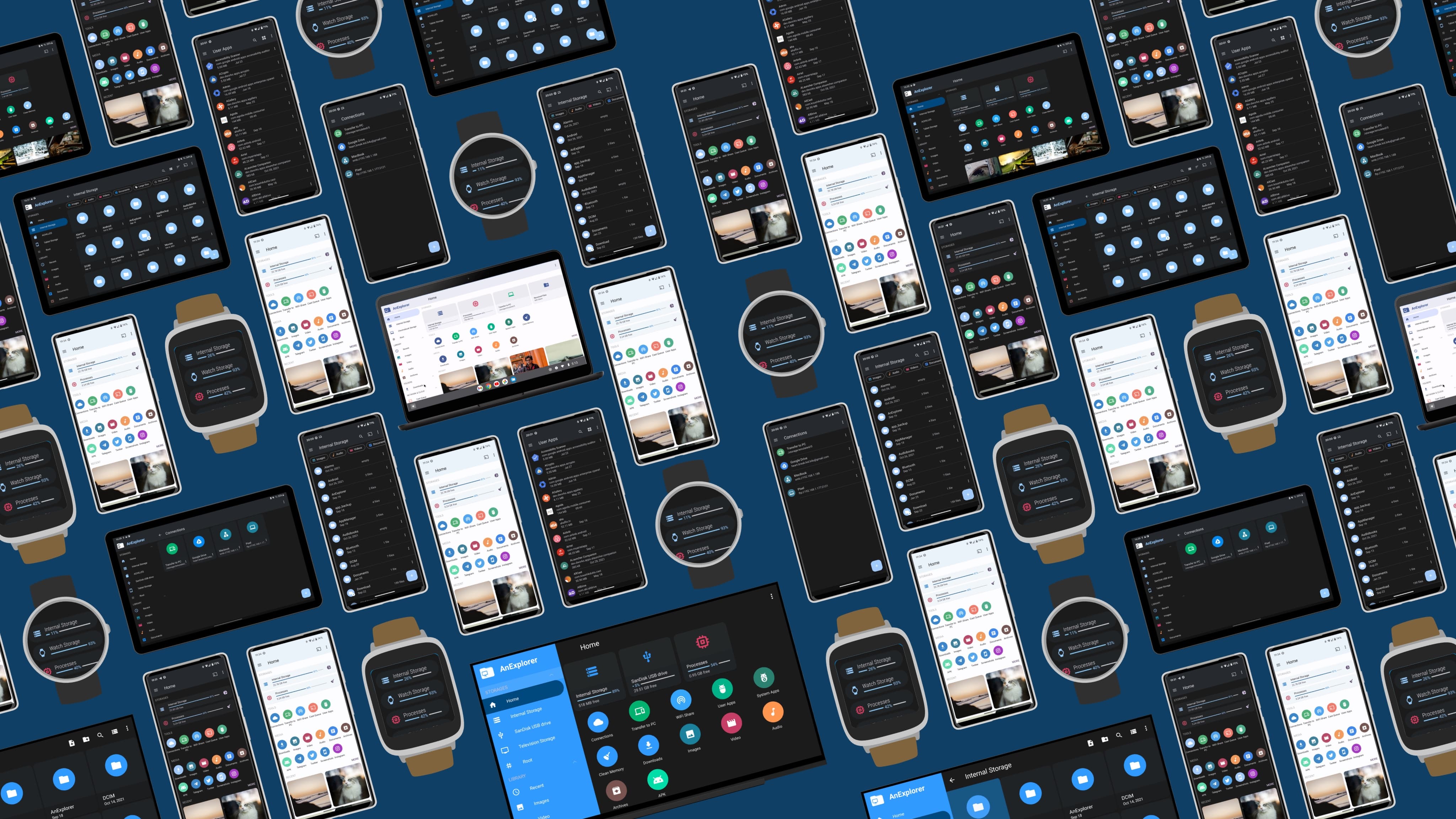
Transfer Files from Phone to Android TV — All Methods Covered
Getting files onto an Android TV, Fire TV, or Google TV device is one of the most common transfer scenarios — pushing movies for offline playback, sideloading APKs not available in the TV's app store, sharing photos for a slideshow, or loading local music. These devices typically lack card slots and convenient USB ports, making wireless transfer the practical choice.
AnExplorer works across the entire Android TV ecosystem — Android TV, Amazon Fire TV, Google TV, Nvidia Shield, and Xiaomi Mi Box. The TV-optimized version features remote navigation, D-pad control, and large-screen layouts designed for 10-foot viewing distances.
This guide covers every method from the phone side, with device-specific notes for each TV platform.
Method 1: Wi-Fi Share (Phone Sends, TV Receives — Fastest Setup)
Wi-Fi Share creates a direct transfer connection between your phone and TV. Both devices need AnExplorer installed.
On your Android TV / Fire TV / Google TV (receiving):
- Launch AnExplorer on your TV using the remote
- Navigate to Wi-Fi Share in the sidebar (press left on D-pad to open sidebar)
- Select Receive — the TV enters listening mode, displaying a "waiting for connection" screen
On your Android phone (sending):
- Open AnExplorer on your phone
- Browse to the files you want to send:
- Movies:
/Movies/or/Download/ - Photos:
/DCIM/Camera/ - APKs:
/Download/ - Music:
/Music/
- Movies:
- Long-press to select files — you can select multiple files and entire folders
- Tap Wi-Fi Share or the transfer icon in the toolbar
- Your TV appears in the nearby devices list — tap it
- Transfer starts immediately with a progress bar on both devices
Speed expectations:
| Scenario | Speed | Time for 4 GB Movie |
|---|---|---|
| Both on 5 GHz Wi-Fi | 30–80 MB/s | 50 sec–2 min |
| Phone 5 GHz, TV 2.4 GHz | 5–15 MB/s | 4–13 min |
| TV on Ethernet, phone on 5 GHz | 40–90 MB/s | 45 sec–1.5 min |
| Both on 2.4 GHz | 5–15 MB/s | 4–13 min |
Tip: For large movie transfers (4K files at 10–50 GB), always verify both devices are on 5 GHz. The difference between 2.4 GHz and 5 GHz is dramatic — a 20 GB file takes 4 minutes on 5 GHz vs. 22 minutes on 2.4 GHz.
Method 2: Device Connect on TV — Phone Uploads via Browser
Device Connect runs on the TV as an HTTP server. Your phone's browser accesses it and uploads files. This method is especially useful when you want to select files on your phone's touchscreen rather than navigating with the TV remote.
On your Android TV:
- Open AnExplorer on the TV
- Navigate to Device Connect → select Start
- The TV displays an address:
http://192.168.x.x:8080
On your phone:
- Open any browser (Chrome, Firefox, Samsung Internet)
- Type the TV's address in the URL bar
- The TV's file system appears in the browser
- Tap Upload → select files from your phone → they transfer directly to the TV
- You can also browse and download files FROM the TV to your phone
Device Connect uses HTTP — it is the only server mode in AnExplorer. The browser interface works on any device with a browser, including phones, tablets, laptops, and other TVs.
Method 3: Device Connect on Phone — TV Browser Downloads from Phone
The reverse server setup — your phone runs the server, and the TV accesses it via browser:
On your phone:
- Open AnExplorer → Device Connect → Start
- Note the address:
http://192.168.x.x:8080
On your TV:
- Open a browser on the TV (Silk on Fire TV, Chrome on Android TV, Puffin if sideloaded)
- Navigate to your phone's address using the remote
- Browse your phone's files on the big screen → click to download files to TV storage
This approach lets you see your phone's entire file structure on the TV's large screen — useful for finding specific files in deeply nested folders.
Method 4: FTP Client on TV — Browse Phone Storage
AnExplorer on the TV can connect as an FTP client to FTP servers on your network. If you have a NAS or computer sharing files via FTP, the TV pulls files from there.
On your TV:
- Open AnExplorer → Network → Add Connection → FTP
- Enter the server IP address, port, and credentials
- Connect — remote storage appears in AnExplorer
- Browse, select files, and copy them to your TV's internal storage
This is the ideal method for accessing a centralized media library that multiple devices share.
Method 5: SMB Client on TV — Persistent Network Access
SMB connections persist in AnExplorer's sidebar and reconnect whenever the server is available. Perfect for ongoing access to a NAS or shared computer.
On your TV:
- AnExplorer → Network → Add Connection → SMB
- Enter the server address and credentials
- Connect — the share appears in AnExplorer's sidebar permanently
- Browse and copy files anytime without re-entering details
Method 6: USB Drive Intermediary
When network methods are not available or reliable:
- On phone: connect USB drive via OTG adapter → copy files using AnExplorer
- Physically move USB drive to TV's USB port
- On TV: open AnExplorer → USB drive appears → copy to internal storage or play directly from USB
Most Android TV devices have at least one USB port (Fire TV Cube has USB-A; Nvidia Shield has USB-A and USB-C). Fire TV Sticks lack standard USB ports — they require a powered OTG hub.
Common Transfer Scenarios
Sideloading APKs to Android TV
This is one of the most popular reasons to transfer files to a TV — installing apps not available in the TV's official store.
Workflow:
- Download the APK on your phone (from APK Mirror or similar trusted source)
- Transfer to TV via Wi-Fi Share or Device Connect
- On TV: open AnExplorer → navigate to the transferred APK (usually in
/Download/) - Click the APK → select Install
- If prompted about unknown sources: navigate to Settings → Security → Unknown Sources → enable for AnExplorer
Enable unknown apps installation:
- Fire TV: Settings → My Fire TV → Developer Options → Install Unknown Apps → AnExplorer → Allow
- Android TV: Settings → Security & restrictions → Unknown sources → AnExplorer → Allow
- Google TV: Settings → Privacy → Security → Unknown sources → enable
Popular apps to sideload:
- Streaming apps not available in regional stores
- Alternative launchers (Wolf Launcher, Projectivy Launcher)
- VLC for Android TV (broader codec support than built-in player)
- File managers (AnExplorer itself on platforms where Play Store listing is restricted)
Streaming Local Videos Without Transfer
You do not always need to copy files to the TV. If both devices are on the same network, you can stream directly:
- Start Device Connect on your phone → note the URL
- On TV: open VLC or a media player that supports network URLs
- Enter the direct file URL (navigate Device Connect in TV browser, right-click/long-press the file → copy link)
- VLC streams the file directly from your phone — no storage used on TV
This is useful for one-time viewing without permanently storing the file on the TV.
Photo Slideshows
Transfer a folder of photos to the TV for a family slideshow:
- On phone: select the entire photo album folder
- Transfer via Wi-Fi Share to TV
- On TV: open AnExplorer → navigate to the received photos → use the built-in photo viewer for a slideshow
- Or open the photos with Google Photos on the TV for a polished slideshow experience
Music Background Playback
Transfer your music library for ambient playback:
- On phone: select your
/Music/folder (or specific albums) - Transfer to TV via Wi-Fi Share
- On TV: open a music player (VLC, Musicolet TV, or Google's local player) → play from the transferred folder
Platform-Specific Notes
Amazon Fire TV (All Models)
Fire TV runs Fire OS (Android fork) and fully supports AnExplorer:
- Installation: Available in Amazon Appstore (search "AnExplorer") or sideload via Downloader app
- Developer Options: Settings → My Fire TV → About → tap device name 7 times
- Unknown apps: Settings → My Fire TV → Developer Options → Install Unknown Apps → per-app toggle
- Storage: Fire TV Sticks have only 8–16 GB (4–8 GB usable). Check before transferring large files.
- See the Fire TV-specific guide for more detail.
Nvidia Shield TV (Pro and Tube)
The most powerful Android TV box with excellent network performance:
- Installation: Google Play Store
- Ethernet: Shield Pro has gigabit Ethernet — connect via cable for fastest transfers (80–100 MB/s)
- Storage: Shield Pro has 16 GB internal + expandable via USB or microSD (formatted as adoptable storage)
- USB-A ports: Two full USB-A ports for external drives — great for large media libraries
- See the Nvidia Shield guide for model-specific setup.
Google TV (Chromecast 4K, TCL, Hisense, Sony)
Google TV's file management is more restricted than stock Android TV:
- Installation: AnExplorer available in Google Play Store on most Google TV devices
- Storage: Chromecast with Google TV has very limited internal storage (4–8 GB usable)
- Workaround for storage limits: Transfer to a USB drive attached to the TV rather than internal storage
- Restricted builds: Some manufacturers limit Play Store app visibility — sideload if needed
Xiaomi Mi Box / Mi Stick
Standard Android TV interface — fully compatible:
- Installation: Google Play Store
- Wi-Fi: Mi Box S supports 5 GHz Wi-Fi (AC), Mi Stick supports Wi-Fi 5
- Storage: 8 GB internal, limited usable space — USB expansion recommended for media
- All transfer methods work without special configuration
Speed Comparison Table
| Method | Speed | Setup Complexity | Best For |
|---|---|---|---|
| Wi-Fi Share (5 GHz) | 30–80 MB/s | Low (install on both) | Quick batch transfers |
| Device Connect (TV as server) | 30–80 MB/s | Low (browser on phone) | Phone-side file selection |
| Device Connect (phone as server) | 30–80 MB/s | Low (browser on TV) | TV-side browsing |
| FTP client | 30–60 MB/s | Medium | NAS/server access |
| SMB client | 30–60 MB/s | Medium | Persistent network drives |
| USB drive | 20–80 MB/s | Medium (physical swap) | No network available |
| Bluetooth | N/A | N/A | Not practical for TV transfers |
Troubleshooting
TV does not appear in Wi-Fi Share nearby devices
- Confirm both phone and TV are on the same local network (same router, same SSID)
- Some TVs only support 2.4 GHz — if your phone connects to a different band with client isolation, they cannot communicate. Try connecting both to the same band.
- On Android 12+ phones: check that AnExplorer has "Nearby Devices" permission (Settings → Apps → AnExplorer → Permissions)
- Restart AnExplorer on both devices — kill the app fully and reopen
- Some routers have AP isolation (client isolation) that blocks device-to-device traffic — disable it in router settings
APK fails to install on TV
- "Unknown sources" not enabled: Enable per-app unknown source permission for AnExplorer (see platform-specific instructions above)
- Architecture mismatch: The APK is compiled for x86 — most TV boxes use ARM64. Download the correct architecture version.
- Android version incompatible: Fire TV Sticks run Android 9–11 depending on model. Check the APK's minimum Android version requirement.
- Insufficient storage: Fire TV Sticks fill up fast. Clear cache or uninstall unused apps first.
Transfer starts but hangs or drops
- TV's Wi-Fi may be weaker than phone's — move the TV closer to the router or connect via Ethernet (if available)
- Disable battery optimization on your phone: Settings → Apps → AnExplorer → Battery → Unrestricted
- Keep the phone screen on during transfer — some devices throttle network when screen is off
- Pause any active video streaming on the TV during file transfer (streaming and file transfer compete for bandwidth)
Video transferred but won't play on TV
The TV's built-in player may not support the codec. Solutions:
- Install VLC for Android TV — handles virtually any format (MKV, AVI, HEVC, VP9, etc.)
- If video plays but stutters: the file's bitrate exceeds TV hardware decoding capability. Transcode to H.264/AAC in MP4 container before transfer.
- Verify the file is not corrupted — play it on the source phone first
- Check subtitle files: if you transferred
.srtor.asssubtitle files, place them in the same folder as the video with matching filenames
Device Connect address not reachable from phone browser
- Verify TV shows "Server running" status in AnExplorer
- Check TV's Wi-Fi is connected (not just Ethernet — some TVs disconnect Wi-Fi when Ethernet is active)
- Try the URL from a computer to isolate whether the issue is phone-specific or TV-specific
- Some VPN apps on the phone or TV change routing — disable VPNs during transfer
Related Guides
- Transfer TV to Phone — Pull files from TV storage to phone
- Transfer Phone to Fire TV — Fire TV-specific sideloading guide
- Transfer Android to TV (All Sources) — Tablet and foldable to TV
- Android to Android Transfer — Phone-to-phone Wi-Fi Share
- Nvidia Shield Guide — Shield-specific setup