
Transfer Files Between Android Devices — The Complete Guide
Bluetooth file transfer on Android is painfully slow — typically 2–3 Mbps, meaning a 1 GB video takes nearly 10 minutes. WhatsApp and Telegram compress images and videos. Google Photos syncing requires internet and a Google account. USB cables require having the right cable at the right moment. There is a better approach for every scenario.
AnExplorer's Wi-Fi Share creates a direct connection between two Android devices and transfers files at real Wi-Fi speeds — typically 30–80 MB/s on a standard 5 GHz network. No internet required, no cloud account needed, no cable necessary. It works for phone-to-phone, phone-to-tablet, tablet-to-tablet, and any other Android device combination.
Method 1: Wi-Fi Share (Direct Peer-to-Peer)
This is AnExplorer's peer-to-peer transfer mode — the fastest method for direct device-to-device file transfers.
Requirements:
- AnExplorer installed on both Android devices
- Both devices connected to the same Wi-Fi network (no internet needed — the Wi-Fi network just needs to exist)
On the receiving device:
- Open AnExplorer → tap the menu (☰)
- Tap Wi-Fi Share
- Tap Receive — a "waiting for sender" screen appears with the device name displayed
On the sending device:
- Open AnExplorer → tap the menu (☰)
- Tap Wi-Fi Share → tap Send
- Navigate to the files you want to transfer
- Long-press to select files → select multiple files and entire folders as needed
- Tap Wi-Fi Share or Send in the action bar
- Your receiving device appears in the nearby list — tap it to connect
- Transfer starts immediately with a progress bar showing speed and remaining time
Received files location:
Files appear in the Received Files section within Wi-Fi Share on the receiving device. A notification confirms completion. Default location is /AnExplorer/Received/ — you can then move files to their permanent location.
Speed expectations:
| Network Condition | Transfer Speed | Time for 1 GB | Time for 10 GB |
|---|---|---|---|
| 5 GHz Wi-Fi (close to router) | 40–80 MB/s | 13–25 sec | 2–4 min |
| 5 GHz Wi-Fi (moderate distance) | 20–40 MB/s | 25–50 sec | 4–8 min |
| 2.4 GHz Wi-Fi | 5–15 MB/s | 1–3 min | 11–33 min |
| Bluetooth (for comparison) | 2–3 MB/s | 5–8 min | 55–85 min |
Wi-Fi Share is 10–30x faster than Bluetooth for the same file.
Method 2: Device Connect (HTTP Server)
If both devices are on the same Wi-Fi network, one device hosts an HTTP server and the other browses and downloads from it via browser. This works even if only one device has AnExplorer — the other just needs a browser.
On the hosting device (source of files):
- Open AnExplorer → Device Connect
- Tap Start — note the address:
http://192.168.x.x:8080 - Keep AnExplorer open
On the second device (receiver):
- Open any browser (Chrome, Firefox, Samsung Internet)
- Type
http://192.168.x.x:8080in the address bar - The host device's file system appears in the browser
- Click files to download them
- Use the Upload button to send files in the reverse direction
Device Connect uses HTTP — it is the only server mode in AnExplorer. This method is excellent when the receiving device does not have AnExplorer installed, since any browser works.
When to use Device Connect over Wi-Fi Share:
- Only one device has AnExplorer installed
- You want to browse the source device's full storage before deciding what to download
- You need bidirectional transfer (download AND upload) in one session
- The receiving device is a computer, Chromebook, or TV with a browser
Method 3: FTP Client — Connect to Network Resources
AnExplorer's FTP client lets one device connect to FTP servers on your network. If you have files on a NAS, computer, or another device sharing via FTP, both Android devices can independently pull from the same source.
Connecting to a server from your Android device:
- Open AnExplorer → Network → Add Connection → FTP
- Enter the FTP server IP address, port (usually 2221), and credentials
- Tap Connect — the server's files appear in AnExplorer
- Browse, select files, and copy to local storage
Available client protocols in AnExplorer:
- FTP — Standard File Transfer Protocol
- SFTP — Secure FTP over SSH (encrypted)
- SMB — Windows/Samba network shares
- WebDAV — Web-based file access (Nextcloud, ownCloud, etc.)
These are all client modes — your device connects TO an existing server. They are distinct from Device Connect which is the only server mode (HTTP).
Method 4: USB OTG with Flash Drive
When no Wi-Fi network exists (camping, rural areas, events):
- Connect USB flash drive to first phone via OTG adapter
- Open AnExplorer → copy files to USB drive
- Disconnect USB drive from first phone
- Connect USB drive to second phone via OTG adapter
- Open AnExplorer → copy files from USB drive to second phone
Speed: 20–80 MB/s depending on drive type. Zero network dependency. See the phone to USB guide for detailed OTG instructions.
Method 5: Cloud Bridge (When Devices Are Separate)
When two devices are in different locations (different cities, different networks):
- On source device: upload files to a cloud provider (Google Drive, Dropbox, OneDrive) using AnExplorer's cloud integration
- On destination device: download from the same cloud provider
Speed depends entirely on internet upload/download bandwidth — typically 2–20 MB/s. Requires internet on both devices.
Switching Phones — Complete Transfer Checklist
When migrating from an old Android phone to a new one, here is what to transfer and where to find it:
Photos and Videos (Highest Priority)
- Location:
/DCIM/Camera/— your entire camera roll - Also check:
/DCIM/Screenshots/,/Pictures/Instagram/,/Pictures/Twitter/, and app-specific subdirectories - Method: Select the entire
DCIMfolder and transfer in one batch via Wi-Fi Share - Size estimate: 10–200 GB depending on years of photos
WhatsApp Data
- Location:
/Android/media/com.whatsapp/WhatsApp/(Android 11+) or/WhatsApp/(older Android) - Contains: Images, Videos, Audio, Documents, Voice Notes, Stickers
- Method: Transfer the entire
WhatsAppfolder to preserve all media - Important: Chat message history must be restored through WhatsApp's built-in backup (Google Drive backup), not via file transfer. But all media files transfer correctly.
Downloads
- Location:
/Download/ - Contains: Browser downloads, APKs, documents, email attachments
- Easy to forget — always include this folder in migration
Music
- Location:
/Music/ - Also check:
/Ringtones/for custom ringtones and notification sounds - Note: If you use streaming (Spotify, YouTube Music), just log in on the new phone — no file transfer needed
Documents
- Location:
/Documents/,/Download/, app-specific folders - PDF files from readers often live in
/Android/data/com.adobe.reader/files/or similar app-specific paths - Note: Scoped storage (Android 11+) restricts access to some app folders
App Data and APK Backups
- APK files: AnExplorer can extract APK files from installed apps for backup
- App settings and data: Most apps use their own cloud backup (WhatsApp → Google Drive, Signal → its own backup, etc.)
- Root users: With root access,
/data/data/contains all app databases and settings
SMS and Call History
- These cannot be transferred via file manager — use a dedicated SMS backup app (SMS Backup & Restore) or Google's built-in device transfer tool
Transfer Speed Comparison — All Methods
| Method | Speed | Internet Required | Both Need AnExplorer | Best For |
|---|---|---|---|---|
| Wi-Fi Share | 30–80 MB/s | ❌ No | ✅ Yes | Fastest local transfer |
| Device Connect (HTTP) | 30–80 MB/s | ❌ No | ❌ No (browser works) | One device without app |
| FTP client | 30–60 MB/s | ❌ No | N/A (server needed) | NAS/server access |
| SMB client | 30–60 MB/s | ❌ No | N/A (share needed) | Windows PC/NAS |
| USB OTG drive | 20–80 MB/s | ❌ No | ❌ One device | No network available |
| Bluetooth | 2–3 MB/s | ❌ No | ❌ Built-in | Tiny files, no app |
| Cloud (Drive/Dropbox) | 2–20 MB/s | ✅ Yes | ❌ No | Devices in different locations |
| Quick Share (Google) | 5–30 MB/s | ❌ No | ❌ Built-in | Quick small file share |
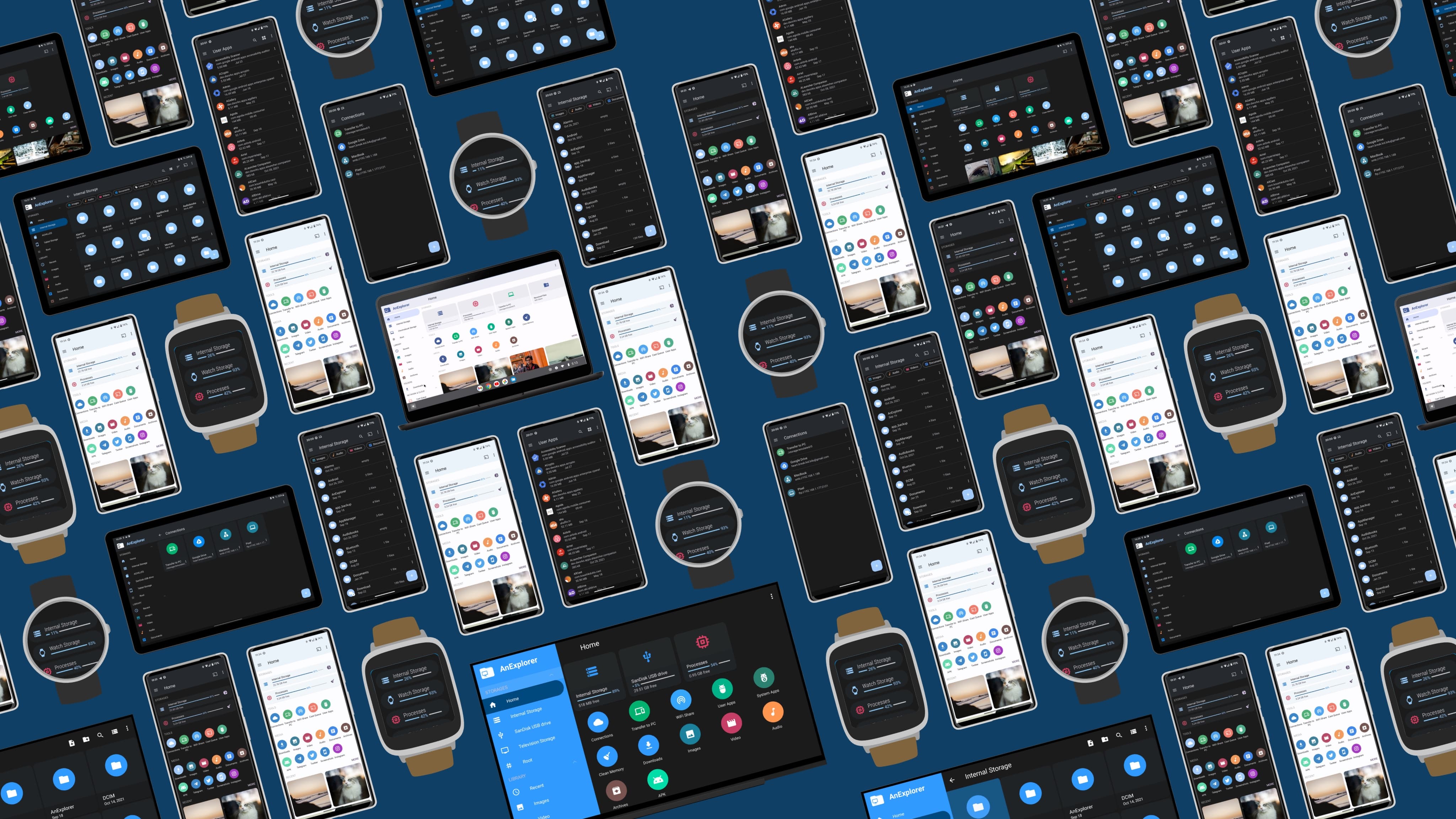
Transferring Between Different Screen Sizes
Phone to Tablet
Same process applies. Wi-Fi Share and Device Connect work identically regardless of device size. AnExplorer's interface adapts to tablet screens with more content visible. See the Phone to Tablet guide for tablet-specific tips.
Phone to Android TV
Android TV devices run AnExplorer too — the TV version is optimized for D-pad and remote navigation. Wi-Fi Share works with the TV as receiver. See the Android to TV guide for remote-accessible instructions.
Phone to Chromebook
Chromebooks can run Android apps (including AnExplorer) and access Device Connect via Chrome browser. See the Android to Chromebook guide for ChromeOS-specific methods.
Phone to Wear OS Watch
Wear OS watches have limited storage and slower Wi-Fi — transfers are slower (1–5 MB/s) but the same principles apply. See the Phone to Watch guide.
Device-Specific Tips
Samsung Galaxy phones
- Samsung's Quick Share works between Samsung devices but is limited to Samsung ecosystem
- AnExplorer's Wi-Fi Share works between any brands — Samsung to Pixel, Xiaomi to OnePlus, etc.
- DeX mode on Samsung phones provides a desktop interface — useful for managing large transfers
Google Pixel phones
- Pixel phones have excellent Wi-Fi hardware — expect top speeds with Wi-Fi Share
- Quick Share (Google's built-in) works but is less reliable for large batches than AnExplorer
Xiaomi/Redmi/POCO phones
- MIUI and HyperOS aggressively kill background apps — set AnExplorer to "No restrictions" in Battery settings before transferring
- Xiaomi's Mi Share only works between Xiaomi devices — AnExplorer works cross-brand
OnePlus/Oppo/Realme phones (ColorOS/OxygenOS)
- Similar aggressive battery management — whitelist AnExplorer in battery optimization
- These phones have excellent Wi-Fi 6/6E hardware — fast transfer speeds
Troubleshooting
Second device does not appear in Wi-Fi Share
- Both devices must be on the same Wi-Fi network — verify they show the same SSID in Wi-Fi settings
- Both devices need Wi-Fi turned on (even if not connected to any internet — the Wi-Fi hardware needs to be active for local discovery)
- On Android 12+, Wi-Fi Share requires "Nearby Devices" permission — check Settings → Apps → AnExplorer → Permissions
- If discovery takes more than 30 seconds, force-close AnExplorer on both devices and restart
Transfer stops or freezes mid-way
- Keep both phone screens on during transfer — disable auto-sleep temporarily: Settings → Display → Screen timeout → 10 minutes
- Android throttles network activity when the screen is off on many devices — this interrupts transfers
- Disable battery optimization for AnExplorer on both devices: Settings → Battery → AnExplorer → Unrestricted
- For very large transfers (20+ GB), Device Connect is more resilient than Wi-Fi Share to brief network interruptions
Files transferred but cannot be found
- Check Wi-Fi Share → Received Files section in AnExplorer — that is the dedicated inbox for received files
- Default save location:
/AnExplorer/Received/ - Use AnExplorer's search feature: tap the search icon and search by filename, extension, or file type
- Check AnExplorer's settings for custom receive folder path
Transfer speed is much slower than expected
- Both devices on 2.4 GHz Wi-Fi limits speeds to 5–15 MB/s — switch both to 5 GHz
- Router congestion (many devices streaming/downloading) reduces available bandwidth
- Physical distance from router affects speed — move closer for faster transfers
- Some phones throttle Wi-Fi when battery is low — charge to above 20%
Only one device has AnExplorer — can I still transfer?
Yes — use Device Connect (Method 2). The device with AnExplorer starts the HTTP server. The other device opens any browser and navigates to the displayed URL. No app needed on the second device for browser-based transfers.
Related Guides
- Transfer Android to PC — Move files to Windows wirelessly
- Transfer Android to Mac — Wireless transfer to macOS
- Transfer Phone to Tablet — Tablet-optimized guide
- Transfer Android to TV — TV-compatible file sharing
- Transfer Phone to USB — USB OTG backup guide