
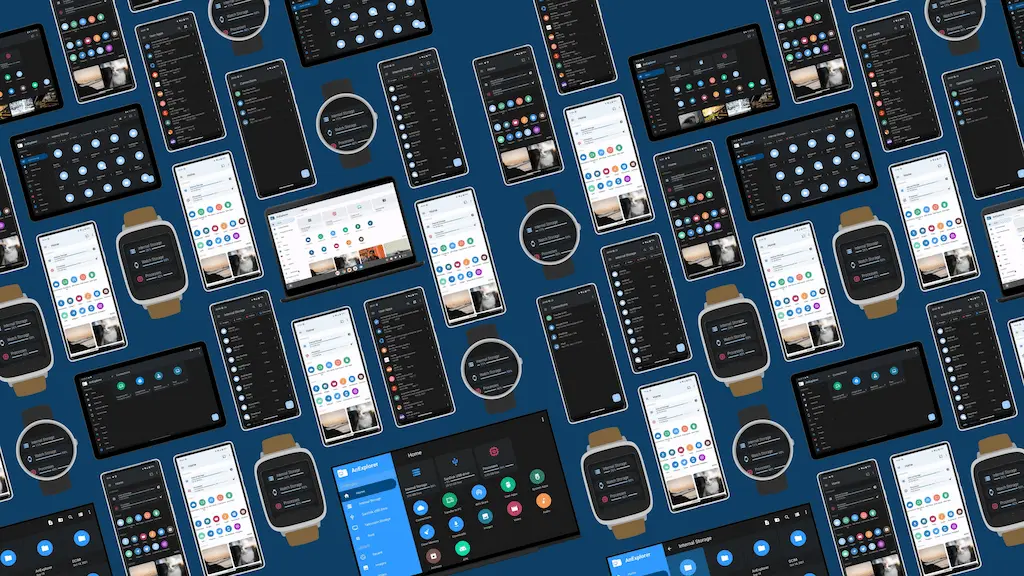
Android TV and Fire TV devices have file systems just like phones and tablets, but they ship with extremely limited file management capabilities. The built-in file browsers (when they exist at all) only show basic folders and cannot access USB drives, network shares, or hidden directories. AnExplorer gives you full access to local storage, USB drives, network files (SMB/FTP), and even your phone's storage — all navigable with your TV remote, game controller, or connected mouse.
Quick Answer
Install AnExplorer on your TV (Google Play Store on Android TV, Amazon Appstore on Fire TV), then use the sidebar to navigate between Internal Storage, USB drives, and Network connections. Tap any media file to play it with your TV's installed media player.
Method 1: Access a USB Drive on Android TV
Plugging a USB drive into your TV's USB port is the simplest way to bring files to the big screen. Android TV supports FAT32 and exFAT drives without any configuration:
- Plug the USB drive into your TV's USB port (USB-A on most TVs, USB-C on newer streamers)
- Wait a few seconds — Android TV may show a notification that a drive was detected (you can dismiss it)
- Open AnExplorer on the TV
- In the left sidebar, tap USB Storage or the drive's label name
- Browse your files — navigate folders with the remote's directional pad
- Tap any video, music file, or photo to open it with the default media player
Filesystem compatibility on Android TV:
| Format | Android TV Support | AnExplorer Support | Notes |
|---|---|---|---|
| FAT32 | ✅ Native | ✅ | Most compatible; limited to 4 GB per file |
| exFAT | ✅ Native | ✅ | Recommended for large video files |
| NTFS | ⚠️ Varies by TV | ✅ Full read/write | Use AnExplorer if stock browser cannot read it |
| ext4 | ❌ No native support | ✅ Full read/write | Linux filesystem — AnExplorer handles it |
If your TV's built-in file manager cannot read an NTFS or ext4 USB drive, install AnExplorer — it supports both filesystems natively without any additional configuration.
Method 2: Access Your Phone's Files on Android TV
This is the most useful workflow for most people — you have movies, photos, or documents on your phone and want to view them on the big screen without copying files first.
Using Device Connect (HTTP) — Recommended
Device Connect starts a lightweight HTTP server on your phone that any browser or device on the same network can access:
- On your phone: Open AnExplorer → Device Connect → Start
- Note the address displayed (e.g.,
http://192.168.1.50:8080) - On the TV: Open a web browser (Chrome, Puffin TV Browser, TV Bro)
- Navigate to the address shown on your phone
- Your phone's complete filesystem appears in the browser — navigate folders, tap files to stream or download
Device Connect works over your local WiFi and provides full-speed access. Video files can often be streamed directly from the browser without downloading first.
Using AnExplorer's FTP Client on TV
For persistent access to a phone that runs an FTP server:
- On your phone: Start an FTP server (AnExplorer or any FTP server app) → note the address (e.g.,
ftp://192.168.1.50:2221) - On the TV: Open AnExplorer → Network → Add Connection → select FTP
- Enter the phone's IP address and port
- Save the connection — it appears permanently in AnExplorer's Network section
- Whenever both devices are on WiFi, the phone's storage is accessible from the TV
Using SMB from TV to Access a Phone Running an SMB Share
If your phone exposes files via SMB (Windows-compatible sharing):
- On the TV: Open AnExplorer → Network → Add Connection → SMB
- Enter the phone's IP, share name, and credentials
- Browse files as if they were local
Method 3: Access NAS or Network Shares on Android TV
For movies, music, and documents stored on a NAS (Synology, QNAP, TrueNAS) or a Windows/Mac shared folder:
- Open AnExplorer on your TV → Network
- Tap + Add Connection → select the protocol:
- SMB — for Windows shares, Synology, QNAP, TrueNAS (most common)
- FTP — for dedicated FTP servers
- WebDAV — for Nextcloud or other WebDAV-compatible servers
- Enter the server details:
- Server/IP: Your NAS's local IP (e.g.,
192.168.1.100) or hostname - Share name: The shared folder name (e.g.,
Movies,Media) - Username/Password: Your NAS login credentials
- Server/IP: Your NAS's local IP (e.g.,
- Tap Save — the connection appears permanently in Network
- Browse your NAS files directly — tap media to play on TV
Setup tips for popular NAS brands:
| NAS Brand | Protocol | Port | Setup Notes |
|---|---|---|---|
| Synology DiskStation | SMB | 445 | Enable SMB in Control Panel → File Services |
| QNAP | SMB | 445 | Enable SMB in Control Panel → Network & File Services |
| TrueNAS | SMB | 445 | Create SMB share in Sharing → SMB |
| Windows PC shared folder | SMB | 445 | Right-click folder → Properties → Sharing → Share |
| Nextcloud | WebDAV | 443 | Use WebDAV URL: https://your-server/remote.php/dav/files/username/ |
Method 4: Access the TV's Internal Storage
Android TV has a limited amount of built-in storage (typically 8–32 GB depending on the device). Files stored here include sideloaded APKs, downloaded content, and app data:
- Open AnExplorer on the TV → Home or Internal Storage
- The TV's storage path is
/storage/emulated/0/ - Common useful folders:
/Download/— sideloaded APKs and browser downloads/Movies/— transferred video files/Music/— audio files/Pictures/— image files
- You can create new folders, move files between locations, rename, and delete
On Android TV 11+, some app data folders require explicit permission grants. AnExplorer will prompt you to grant access via the system folder picker on first access.
Opening Media Files on Android TV
When you tap a file in AnExplorer on the TV, it opens with the appropriate installed app:
| File Type | Opens With | Notes |
|---|---|---|
| Video (MP4, MKV, AVI, MOV) | VLC, MX Player, or built-in player | VLC handles the widest format range |
| Music (MP3, FLAC, AAC) | Default music app or VLC | |
| Photos (JPG, PNG, WEBP) | Built-in photo viewer or Google Photos | |
| PDF documents | Google Drive or installed PDF viewer | |
| APK files | Android installer | Tap to install (sideloading) |
| ZIP/RAR/7z archives | AnExplorer's built-in extractor | Extract directly on the TV |
For the best video playback experience on Android TV, install VLC for Android TV or MX Player — they support virtually all video codecs and container formats including MKV with multiple audio tracks and subtitles.
Supported TV Devices
AnExplorer works on all Android-based TV platforms:
| Platform | Install Source | Notable Models |
|---|---|---|
| Android TV | Google Play Store | Sony Bravia, Xiaomi Mi Box, Chromecast with Google TV |
| Google TV | Google Play Store | Chromecast HD/4K, TCL Google TV, Hisense Google TV |
| Amazon Fire TV | Amazon Appstore | Fire TV Stick 4K, Fire TV Stick 4K Max, Fire TV Cube |
| Nvidia Shield | Google Play Store | Shield TV, Shield TV Pro (best performance) |
| Generic AOSP TV boxes | Sideload APK | Various Android TV boxes |
Troubleshooting
AnExplorer Not Available in Your TV's Play Store
Some Android TV builds restrict which apps appear in the TV version of the Play Store. If AnExplorer does not show up:
- Search directly: Use the Play Store search on TV and type "AnExplorer"
- Install from phone: Open play.google.com on your phone, find AnExplorer, tap Install, and select your TV device from the device list
- Sideload: Download the APK on your phone → transfer to TV via USB or Device Connect → install on TV
For Fire TV: search the Amazon Appstore directly, or sideload via the Downloader app.
USB Drive Not Showing in AnExplorer on TV
- Unplug and re-plug the USB drive (wait 5 seconds between)
- If using a Fire TV Stick: these devices use the USB port primarily for power. The 4K Max and Cube models have a dedicated USB data port — check which port you are using
- Try a powered USB hub between the drive and TV — some TV USB ports have insufficient power for larger drives
- Check drive format — NTFS requires AnExplorer specifically (the TV's built-in browser may not support it)
Network Share Connects But Shows No Files
- Double-check username and password (NAS credentials, not your email)
- On Synology: ensure the shared folder has read permissions for that user (Control Panel → Shared Folders → Permissions)
- Try connecting via IP address instead of hostname (hostnames sometimes fail to resolve on TV)
- Verify both the TV and NAS are on the same network subnet
Slow Playback of Large Video Files from Network
- Use a wired Ethernet connection if your TV supports it (Nvidia Shield has Gigabit Ethernet)
- If WiFi only: connect to 5 GHz band for higher throughput
- For 4K video: network speed below 50 Mbps will cause buffering. Consider copying the file to USB first for smooth playback
- Some TVs have limited network buffer sizes — VLC handles buffering better than most stock players
Related Guides
- Transfer Files from Phone to TV — push files from phone to TV storage
- Install APK on Android TV — sideload apps on your TV
- USB Drive Not Detected — fix USB access issues
- Device Connect Feature — HTTP server for wireless file access