
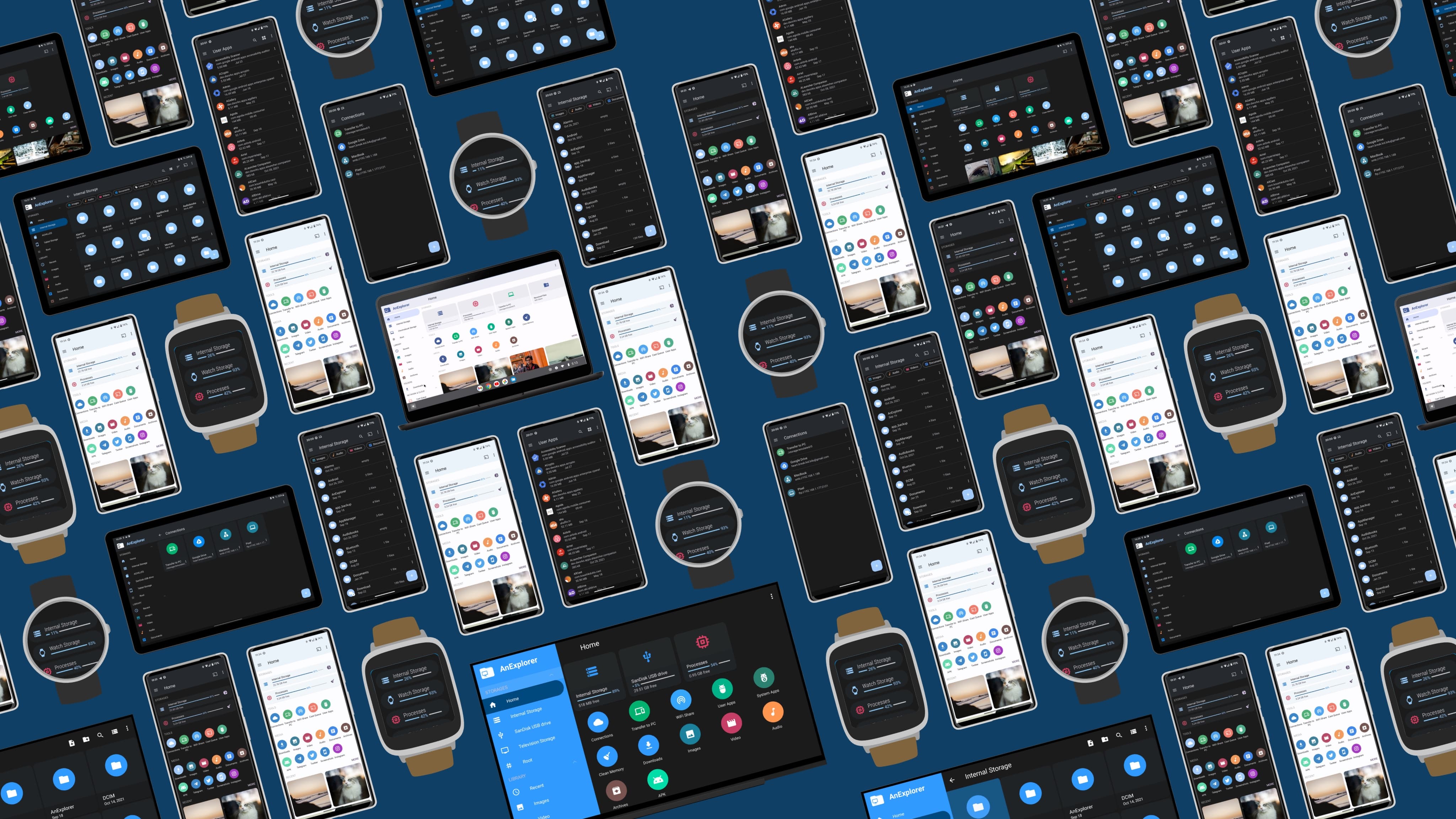
USB Drive Management on Chromebook — Beyond the Basics
Chromebooks have USB ports (USB-C on modern models, sometimes USB-A) and often microSD slots. ChromeOS mounts external storage and provides basic access through its native Files app. But "basic" is the key word — if you need to do anything beyond simple drag-and-drop, you'll hit limitations quickly.
AnExplorer provides proper file management on USB drives: bulk operations, archive handling, better navigation, and the ability to work across multiple storage locations (USB + NAS + cloud) in a unified interface. For anyone who regularly works with external storage on a Chromebook, it's a significant upgrade over the native experience.
Where ChromeOS Files Falls Short
The native ChromeOS Files app handles USB storage with these limitations:
| Task | ChromeOS Files | AnExplorer |
|---|---|---|
| Basic copy/move | ✅ Works | ✅ Works |
| Bulk rename | ❌ One at a time | ✅ Batch rename |
| Extract ZIP on USB | ⚠️ Limited (must copy to internal first) | ✅ Extract directly |
| Extract RAR/7Z | ❌ Not supported | ✅ Supported |
| View hidden files | ❌ Hidden by default, toggle buried | ✅ Easy toggle |
| File details/properties | ❌ Minimal info | ✅ Full details (permissions, timestamps) |
| Copy USB → NAS | ❌ Not possible in one app | ✅ Integrated |
| Copy USB → Cloud | ❌ Manual download/upload | ✅ Direct transfer |
| Sort by type/date/size | ⚠️ Basic sorting | ✅ Advanced sorting and filtering |
| Search within USB | ⚠️ Slow on large drives | ✅ Faster file search |
For basic users, ChromeOS Files works fine. For anyone managing media collections, project files, backup drives, or transferring between multiple storage locations — AnExplorer makes a real difference.
Common USB Use Cases on Chromebook
Media drives for travel
Chromebooks are popular travel laptops. Loading a USB drive with movies, music, and audiobooks before a trip is common. With AnExplorer:
- Browse the media library by folder structure
- Play videos directly (including MKV, AVI formats ChromeOS struggles with)
- Play music files with the built-in player
- Organize content — create folders, rename files, clean up after trips
SD cards from cameras
Photographers and content creators using Chromebooks:
- Insert SD card from camera (DSLR, GoPro, drone)
- Open AnExplorer → navigate to DCIM folder
- Browse photos and video by date
- Copy to internal storage, NAS, or cloud for backup
- Safely manage card contents — delete transferred files to free space
The folder structure on camera SD cards (DCIM, various subfolders) is easy to navigate in AnExplorer, and you can copy entire shoot folders to your NAS or cloud in one operation.
External SSD for projects
USB-C external SSDs (Samsung T7, SanDisk Extreme) provide fast, portable storage:
- Store project files, documents, and media that won't fit on Chromebook's limited internal storage
- Work directly from the SSD — edit documents, access reference materials
- Back up Chromebook files to SSD
- Transfer large file sets between devices (SSD as a shuttle drive)
USB drives for file sharing
Moving files between systems (school, work, home):
- Receive USB drive with documents → browse and copy to Chromebook
- Prepare USB drive with files for someone else
- Access shared departmental drives
Working with Large USB Drives
Many users have 1-4 TB external drives with thousands of files. AnExplorer handles large drives better than the native Files app:
- Faster directory loading — navigating folders with thousands of files
- Better search — find files by name across the entire drive
- Size analysis — see what's consuming space on the drive
- Sorting options — sort by size, date, type, name (ascending/descending)
- Filtering — show only videos, only documents, only images
For a 2 TB media drive with 500+ movies and 10,000+ songs, this makes finding what you need practical rather than tedious.
Archive Operations on USB Drives
USB drives often contain archived files — ZIPs from downloads, RAR files from shared content, 7Z compressed backups. With AnExplorer:
- Extract ZIP directly on USB — no need to copy to internal storage first
- Extract RAR and 7Z — formats ChromeOS doesn't handle natively
- Browse archive contents before extracting — check what's inside without unpacking
- Extract specific files — pull out just what you need from large archives
- Create archives — compress folders on USB into ZIP for sharing
This is particularly useful when USB drives are used as file transfer media and contain compressed content from other systems.
USB to NAS/Cloud Transfer
One of AnExplorer's biggest advantages on Chromebook: transferring files between USB storage and network/cloud storage in a single interface.
USB → NAS workflow
- Connect USB drive to Chromebook
- Connect to NAS via SMB in AnExplorer
- Navigate to source files on USB
- Copy/move to NAS destination
- Files transfer directly — USB → Chromebook → NAS over WiFi
USB → Cloud workflow
- Connect USB drive to Chromebook
- Connect to Google Drive / Dropbox / MEGA in AnExplorer
- Select files on USB
- Upload to cloud storage
- Files transfer through the Chromebook's internet connection
In the native ChromeOS Files app, transferring USB → NAS requires mounting both in the Files app (which doesn't always work reliably for NAS) or using separate apps. AnExplorer provides one interface for all storage locations.
SD Card Reader Support
Beyond built-in SD slots, external USB card readers work on Chromebooks:
| Card type | Reader needed | Works with AnExplorer |
|---|---|---|
| microSD | Built-in slot or USB reader | ✅ |
| SD (full size) | Built-in slot or USB reader | ✅ |
| CompactFlash | USB CF reader | ✅ |
| CFexpress | USB CFe reader | ✅ |
| XD | USB multi-reader | ✅ |
All cards mount as standard USB storage in ChromeOS. AnExplorer sees them the same way — full file management regardless of card type.
File System Considerations
ChromeOS handles these file systems on USB:
| File system | ChromeOS support | Best for |
|---|---|---|
| FAT32 | ✅ Read/Write | Small drives, max compatibility |
| exFAT | ✅ Read/Write | Large drives, cross-platform |
| ext4 | ✅ Read/Write | Linux drives, Chromebook native |
| NTFS | ⚠️ Read-only (some models) | Windows-formatted drives |
Recommendation: Format USB drives as exFAT for use across Chromebook, Windows, Mac, and Android. It supports files over 4 GB (FAT32's limitation) and works everywhere.
AnExplorer works with whatever file system ChromeOS mounts — it doesn't care about the underlying format, only that the OS provides access.
USB-C Hub Scenarios
Modern Chromebooks often have only USB-C ports. A USB-C hub expands your options:
- USB-C hub with USB-A ports → use standard USB drives
- USB-C hub with SD card reader → access camera cards
- USB-C hub with HDMI → external display while managing USB files
- Multiple USB devices simultaneously → copy between two USB drives
AnExplorer sees all connected storage regardless of how it's connected (direct USB-C, hub, adapter).
Performance Tips
- USB 3.0/3.1 drives — significantly faster than USB 2.0 for large file operations. Most modern Chromebooks have USB 3.0+ ports.
- Avoid copying thousands of small files — bundle into an archive first, then transfer and extract. Faster than individual file copies.
- SSD vs HDD — external SSDs are dramatically faster than spinning drives for random access (browsing, searching, opening files).
- Don't eject during operations — always wait for copy/move operations to complete. Use ChromeOS's eject button in the Files app or notification area before disconnecting.
Encrypted USB Drives
If your USB drive contains sensitive data:
- AnExplorer can browse encrypted containers (if the OS mounts them)
- Hardware-encrypted drives (like Kingston IronKey) work if ChromeOS supports the encryption method
- For file-level encryption, AnExplorer's built-in encryption feature can encrypt/decrypt individual files on USB storage
Related Guides
- USB OTG Feature — full USB OTG capabilities
- File Manager for Chromebook — complete ChromeOS guide
- Video Player for Chromebook — play media from USB
- Archive Manager — handle compressed files on USB