
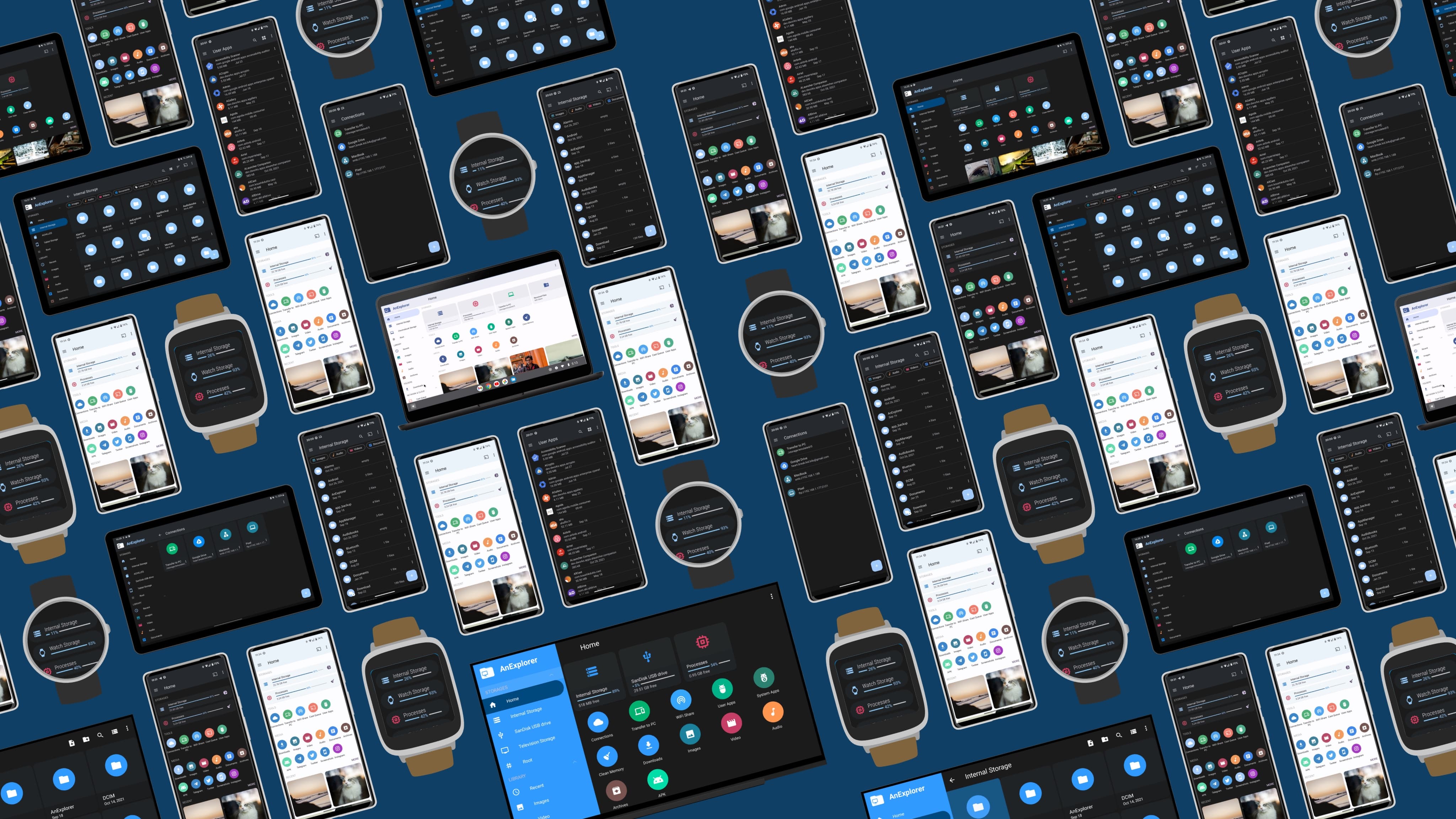
Quick Share vs AnExplorer — Different Tools for Different Jobs
Quick Share (Google's rebrand of Nearby Share, merged with Samsung's Quick Share in 2024) is Android's built-in file sharing feature. It's pre-installed on every Android phone and works without any setup. AnExplorer's Device Connect is a wireless transfer feature built into a full file manager.
They solve overlapping problems but with different strengths. Understanding when to use each saves time and frustration.
Feature Comparison
| Feature | Quick Share | AnExplorer Device Connect |
|---|---|---|
| Pre-installed | ✅ (built into Android) | ❌ (install from Play Store) |
| Phone → Phone | ✅ (excellent) | ✅ (via browser) |
| Phone → Windows PC | ✅ (requires app install) | ✅ (any browser, no install) |
| Phone → Mac | ❌ | ✅ (Safari/Chrome) |
| Phone → Linux | ❌ | ✅ (any browser) |
| Phone → iPhone/iPad | ❌ | ✅ (Safari) |
| Phone → Android TV | ❌ | ✅ (AnExplorer on TV) |
| Phone → Wear OS | ❌ | ✅ (AnExplorer on watch) |
| Phone → VR headset | ❌ | ✅ (AnExplorer on Quest) |
| Multiple files at once | ✅ | ✅ |
| Folder transfer | ❌ (files only) | ✅ (download as ZIP) |
| File size limit | None | None |
| Requires same network | No (uses WiFi Direct) | Yes (same WiFi network) |
| Works offline | ✅ (Bluetooth + WiFi Direct) | ❌ (needs WiFi network) |
| Speed | 20-50 MB/s (WiFi Direct) | 20-80 MB/s (WiFi network) |
| Browse phone files from PC | ❌ | ✅ (web interface) |
| Upload from PC to phone | ❌ (one-way only) | ✅ (bidirectional) |
| No app needed on receiver | ❌ (needs Quick Share/Android) | ✅ (just a browser) |
| Account required | Google account | None |
| Privacy | Google servers for discovery | Local network only |
When Quick Share Wins
Sharing photos with a friend standing next to you: Quick Share is perfect for this. Tap share → select their device → done. No URLs to type, no network to connect to. It uses Bluetooth for discovery and WiFi Direct for transfer — works even without a WiFi network.
Phone-to-phone between Android users: If both people have Android phones, Quick Share is the fastest way to send a few photos or a video. Built-in, no setup, no app to install.
Sharing without WiFi: Quick Share works via WiFi Direct — it creates its own connection between devices. AnExplorer's Device Connect requires both devices to be on the same WiFi network. In a park, on a train, or anywhere without WiFi, Quick Share still works.
Sharing with nearby Chromebooks: Quick Share is deeply integrated into ChromeOS. Receiving files on a Chromebook from an Android phone is seamless.
When AnExplorer Device Connect Wins
Transferring to a PC (any OS): Device Connect works with any browser on any operating system. No app to install on the PC. Quick Share requires installing the "Quick Share for Windows" app — and doesn't work on Mac or Linux at all.
Transferring to iPhone/iPad/Mac: Quick Share doesn't work with Apple devices. Device Connect works with Safari on any Apple device — just type the address.
Browsing phone files from PC: Device Connect provides a web interface where you can browse your entire phone file system from your PC's browser. Quick Share only sends specific files you select on the phone — you can't browse from the PC side.
Uploading files FROM PC to phone: Quick Share is one-directional (phone sends to PC). Device Connect is bidirectional — you can upload files from your PC to your phone through the same web interface.
Transferring entire folders: Quick Share sends individual files. Device Connect lets you download entire folders as ZIP archives from the web interface.
Transferring to Android TV, Wear OS, VR: Quick Share doesn't work on TV, watch, or VR headset. AnExplorer runs on all of these — transfer files to your TV for playback, to your watch for offline use, or to your VR headset for sideloading.
No Google account needed: Device Connect requires zero accounts. Quick Share requires both devices to have Google accounts (and visibility settings configured).
Privacy: Device Connect transfers happen entirely on your local network. Quick Share uses Google's servers for device discovery (though file data transfers directly between devices).
Speed Comparison
On the same WiFi network:
| Scenario | Quick Share | Device Connect |
|---|---|---|
| 10 photos (50 MB total) | ~3 seconds | ~2 seconds |
| 1 GB video | ~25 seconds | ~15-20 seconds |
| 5 GB folder | N/A (no folder transfer) | ~1.5-3 minutes |
Quick Share has slightly more overhead due to WiFi Direct connection establishment (1-3 seconds). Once connected, both are limited by WiFi speed. Device Connect is often faster because it uses your existing WiFi infrastructure (which may be WiFi 6/6E/7) rather than WiFi Direct (which negotiates its own connection).
Using Both Together
The best approach for most users:
- Quick Share for: sharing photos/videos with friends, sending files to another Android phone nearby, quick one-off transfers
- Device Connect for: PC transfer (especially Mac/Linux), browsing phone from PC, uploading to phone, TV/watch/VR transfer, bulk file operations
They don't conflict — both can be available on the same phone simultaneously.
Quick Share Limitations You Should Know
Visibility settings confusion: Quick Share has complex visibility settings (Everyone, Contacts, Your devices). If the receiving device doesn't appear, it's usually a visibility setting issue. Device Connect has no visibility settings — just type the address.
Windows app required: To receive files on a Windows PC, you must install "Quick Share for Windows" from Google. It's a separate download, requires a Google account sign-in, and runs as a background service. Device Connect needs nothing installed — just a browser.
No Mac or Linux support: Google has not released Quick Share for macOS or Linux. If you use a Mac for work or run Linux, Quick Share simply doesn't work for PC transfer. Device Connect works on all operating systems.
One-way transfer: Quick Share sends files FROM your phone TO another device. You can't use it to send files FROM your PC TO your phone. Device Connect is fully bidirectional.
No file browsing: With Quick Share, you must select files on the sending device first. You can't browse the sender's files from the receiving device. Device Connect provides a full file browser accessible from any connected device.
Setting Up Device Connect
- Install AnExplorer from Play Store
- Open AnExplorer → ☰ → Device Connect → Start
- Note the address shown (e.g.,
http://192.168.1.42:8080) - On any other device: open browser → type address → Enter
- Browse, download, upload — no account, no pairing, no app on the other end
Related Guides
- AnExplorer vs LocalSend — another transfer tool comparison
- AnExplorer vs AirDroid — remote access comparison
- Transfer Android to PC — complete transfer guide
- Device Connect — AnExplorer's wireless transfer feature