
Android-based VR headsets have local storage — for apps, sideloaded APKs, screenshots, video captures, and downloaded content. Managing these files requires a file manager that works inside the headset UI. Most phone file managers cannot run on VR headsets at all, and even fewer provide an interface that works with controller input or hand tracking.
This guide covers every viable option for VR file management across Meta Quest, Pico, HTC Vive XR, Samsung Galaxy XR, and other Android-based headsets.
VR File Management — Why It's Different
VR headsets present unique challenges that phone file managers weren't designed to handle. The input model, display rendering, and storage access all differ from standard Android phones.
| Challenge | Details |
|---|---|
| No phone-style touchscreen | VR headsets use controller raycasting or hand tracking for UI interaction |
| Sideloaded APK management | Many VR apps are distributed as APK/APKM files outside the Meta Store |
| Large video files | 360° video, game captures can be 10+ GB |
| Transferring from PC | Moving files wirelessly is faster than USB in a headset |
| No standard desktop access | Meta Quest doesn't appear as a drive on Mac (limited on Windows) |
| Standalone operation | Many users want to manage files without removing the headset |
| Storage capacity | 128GB or 256GB fills quickly with VR content |
Top File Managers for VR Headsets
1. AnExplorer — Best Overall (Purpose-Built for VR)
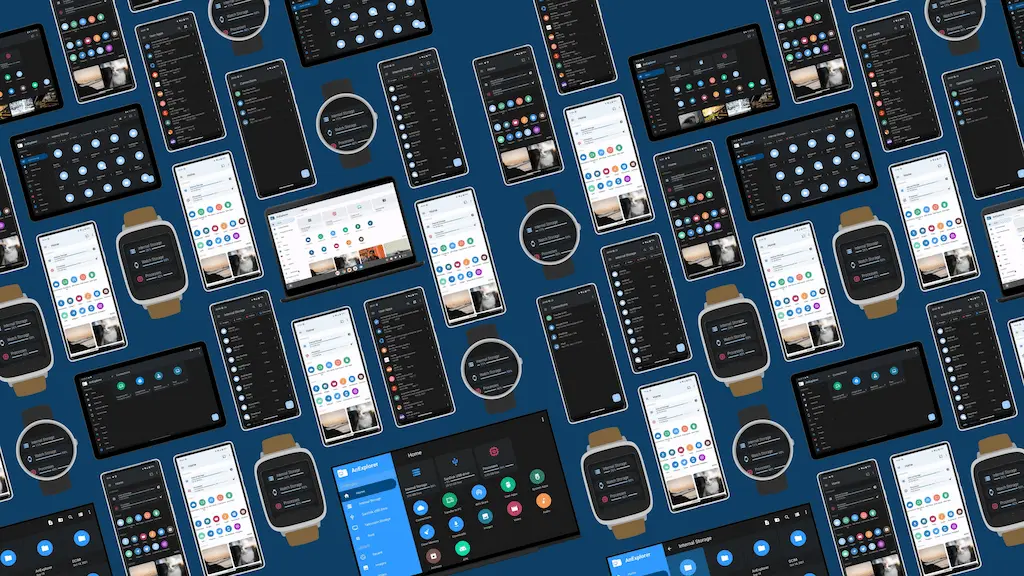
AnExplorer is available on the Meta Horizon Store and runs natively in the Quest's Android environment with controller and hand-tracking input. It is the only file manager with official distribution on VR storefronts.
Supported headsets:
- Meta Quest 3 (main focus)
- Meta Quest 3S
- Meta Quest 2
- Meta Quest Pro
- Pico 4 / Pico 4 Ultra
- HTC Vive XR Elite
- Samsung Galaxy XR
- XREAL device sideload
- Rokid Max (Android-based)
What you can do on the headset:
- Browse internal storage and sideloaded app files
- Transfer files wirelessly from PC/Mac using Device Connect — open a browser on your PC, browse headset storage, no USB needed
- Connect to SMB/NAS for large video transfers at full local Wi-Fi speed
- Move APK files between folders and install from storage
- Install APKM, APKS, and XAPK bundle files (common for sideloaded VR games)
- Extract ZIP and other archives (useful for packed game asset files)
- Connect to FTP/SFTP servers for remote file access
- Browse cloud storage (Google Drive, Dropbox, OneDrive, Box, pCloud, MEGA, Yandex)
Limitations: No dual-pane view. No scheduled sync from cloud to local. No file encryption vault. Interface is functional but not spatially immersive (runs as a 2D panel in VR space).
2. FX File Explorer — Partial Compatibility
FX File Explorer can be sideloaded on Meta Quest and Pico headsets. It runs but is not optimised for VR input — buttons may be difficult to target with controller raycasting, and the phone-sized UI can feel cramped in a VR panel.
Pros: FTP/SMB/SFTP support, root access (FX Plus), cloud storage Cons: Not optimised for VR input, no official VR store distribution, UI is phone-sized
3. Files by Google — Not Compatible
Files by Google does not run on VR headsets and has no VR-compatible version.
4. Solid Explorer — Not Compatible
Solid Explorer has no headset support and cannot be sideloaded to work meaningfully on Meta Quest or Pico devices.
5. MiXplorer — Not Compatible
MiXplorer has no VR version and is not designed for controller or hand-tracking input.
Full Feature Comparison for VR
| App | Meta Quest | Pico 4 | HTC Vive XR | Samsung Galaxy XR | Controller input | Hand tracking |
|---|---|---|---|---|---|---|
| AnExplorer | ✅ Horizon Store | ✅ Pico Store | ✅ Sideload | ✅ | ✅ | ✅ |
| FX File Explorer | ⚠️ Sideload only | ⚠️ Sideload only | ⚠️ Sideload | ⚠️ | Partial | ❌ |
| ES File Explorer | ❌ | ❌ | ❌ | ❌ | N/A | N/A |
| Solid Explorer | ❌ | ❌ | ❌ | ❌ | N/A | N/A |
| MiXplorer | ❌ | ❌ | ❌ | ❌ | N/A | N/A |
| Files by Google | ❌ | ❌ | ❌ | ❌ | N/A | N/A |
| X-plore | ⚠️ Sideload only | ⚠️ Sideload only | ❌ | ❌ | Partial | ❌ |
AnExplorer is the only purpose-distributed file manager for Android VR headsets with official store presence.
Meta Quest: Transferring Files from PC
The most common headset file operation is transferring video or APK files from a PC. AnExplorer provides multiple approaches that eliminate the frustrating USB workflow.
Device Connect (best for wireless — recommended):
- Open AnExplorer on the Quest
- Start Device Connect → note the IP:port shown on screen
- On your PC browser, navigate to that IP address
- Drag and drop files from the browser directly to the headset
- No cable, no driver installation, no Meta Quest developer mode required
SMB/NAS (best for large libraries):
- If you have a NAS or shared folder on your network, connect to it via SMB in AnExplorer
- Browse your entire media library directly on the headset
- Copy specific files to local storage for offline access
- Transfer speeds depend on your local Wi-Fi (typically 50-100 MB/s on Wi-Fi 6)
FTP (best for automated workflows):
- Open AnExplorer → start the built-in FTP Server (port 2221)
- On PC, open FileZilla or any FTP client, connect to the Quest IP
- Transfer at full local Wi-Fi speed
- Good for scripted or batch transfers
All three methods are faster and easier than using USB with Meta's ADB-based file transfer restrictions, which require developer mode and often disconnect mid-transfer.
Pico 4 — Android Files
Pico 4 runs a full Android 12 environment. AnExplorer installs via APK sideloading or directly from the Pico Store. The use case is similar to Quest: managing local storage, transferring video and APK files wirelessly, and connecting to NAS devices for media streaming.
Pico 4 Ultra adds improved Wi-Fi 6E support, making wireless transfers via Device Connect or SMB significantly faster than on the standard Pico 4.
HTC Vive XR Elite
The HTC Vive XR Elite runs Android and supports sideloaded apps. AnExplorer installs via ADB sideloading and provides the same feature set as on Quest — storage browsing, network transfers, archive management. The Vive XR Elite's pass-through mode combined with AnExplorer's file browser creates a mixed-reality workspace for managing files.
Samsung Galaxy XR
Samsung's Galaxy XR headset runs Android and integrates with the Samsung ecosystem. AnExplorer is compatible and provides file management capabilities including Samsung cloud interoperability, SMB access to Samsung NAS devices, and USB-C drive browsing.
Common VR File Management Tasks
| Task | How with AnExplorer |
|---|---|
| Transfer movies from PC to Quest | Device Connect → drag and drop in browser |
| Install sideloaded VR game | Browse to APK/APKM → tap to install |
| Back up screenshots/captures | Connect to SMB share → copy captures folder |
| Free up headset storage | Browse storage → delete large unused files |
| Access NAS movie library | Network → SMB → browse and play or copy |
| Extract downloaded game mods | Browse to ZIP → extract to game folder |
| Transfer between headsets | Device Connect on both → browser transfer |
Meta Quest Native vs AnExplorer
Meta Quest has no dedicated native file manager — only a limited Photos browser and App Library. For a full feature-by-feature breakdown across every Android device type (VR, TV, AAOS, Wear OS, AR glasses), see the dedicated comparison:
Meta Quest Native File Manager vs AnExplorer
Storage Management Tips for VR
VR headsets fill up fast. A single VR game can take 10-30 GB, and recorded gameplay at high resolution consumes storage rapidly. AnExplorer's storage analyser shows what's consuming space:
- Games and apps: Often the largest consumers (check
/Android/obb/for game data) - Screenshots and captures: Found in
/Oculus/Screenshots/and/Oculus/VideoShots/ - Sideloaded content: Check
/Download/and any custom folders you've created - 360° videos: These can be 5-20 GB each in high quality
Regular maintenance with a file manager prevents the "storage full" warning that blocks new game installations.
Related Guides
- Best Wear OS File Manager
- Best Android TV File Manager
- Meta Quest Native vs AnExplorer detailed comparison
- Transfer files to Meta Quest from phone
- Device Connect — wireless PC browser access