
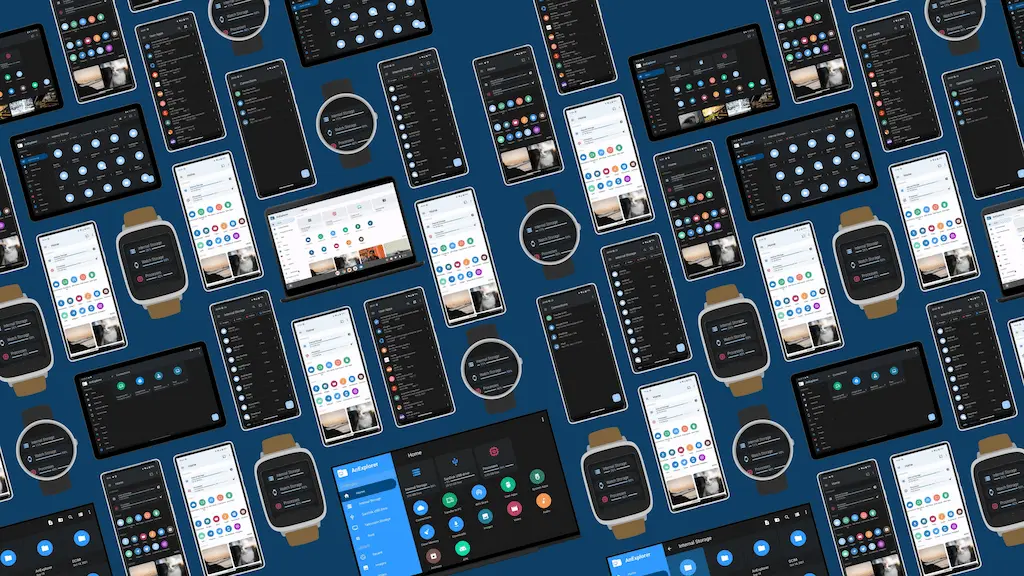
Chromebook's built-in Files app covers most basic tasks. But the moment you need to connect to a NAS, access an FTP server, extract an RAR archive, or sideload an app bundle — you need something with more power.
This guide compares every viable file manager option for ChromeOS users, explains the limitations of each approach, and recommends the best choice for different workflows.
Option 1: ChromeOS Built-In Files App
The Files app that ships with every Chromebook handles:
- Local storage: Downloads, My Files
- Google Drive: Native integration with offline sync support
- USB drives: Plugged via USB-A or USB-C (with hub if needed)
- SD card: If your Chromebook has a microSD slot
- SMB (basic): Settings → Files → Add new service → SMB file share
- ZIP: Built-in ZIP extract and create (right-click context menu)
- Linux storage: If Linux environment (Crostini) is enabled,
/home/[username]is accessible - Android files: If Android apps are enabled, Android storage is partially visible
The built-in app is fast, reliable, and deeply integrated with ChromeOS. It covers approximately 80% of typical Chromebook file needs for average users.
What it cannot do:
- FTP, SFTP, WebDAV, FTPS connections
- RAR, 7z, TAR, ISO archive handling
- APK / bundle installation (needs a separate method)
- Sideloading APKM, APKS, XAPK bundles
- Advanced archive creation with compression options
- NAS browsing beyond simple SMB shares (no FTP to NAS, no SFTP)
- Root access to Android container
- Built-in media playback from network locations
- Connecting to multiple cloud services beyond Google Drive
Option 2: AnExplorer (Android App on Chromebook)
Chromebooks with Android app support (most Chromebooks made after 2017) can install Android apps from the Play Store. AnExplorer is fully compatible with Chromebook and runs as a windowed Android app on ChromeOS.
What AnExplorer adds to Chromebook:
| Feature | Built-in Files | AnExplorer |
|---|---|---|
| Local browsing | ✅ | ✅ |
| Google Drive | ✅ Native | ✅ |
| Dropbox | ❌ | ✅ |
| OneDrive | ❌ | ✅ |
| Box | ❌ | ✅ |
| pCloud | ❌ | ✅ |
| MEGA | ❌ | ✅ |
| Yandex Disk | ❌ | ✅ |
| SMB / LAN shares | ✅ Basic | ✅ Full (better handling) |
| FTP | ❌ | ✅ |
| SFTP | ❌ | ✅ |
| WebDAV | ❌ | ✅ |
| FTPS | ❌ | ✅ |
| NAS (Synology, QNAP, WD) | ❌ | ✅ (SMB + FTP + SFTP) |
| ZIP | ✅ | ✅ |
| RAR / RAR5 | ❌ | ✅ |
| 7z | ❌ | ✅ |
| TAR / TAR.GZ / TAR.BZ2 | ❌ | ✅ |
| ISO | ❌ | ✅ |
| CBR / CBZ | ❌ | ✅ |
| APK install (APKM/APKS/XAPK) | ❌ | ✅ |
| Root support | ❌ | ✅ (rooted Android container) |
| Device Connect (HTTP server) | ❌ | ✅ |
| Text editor | ❌ | ✅ |
| PDF viewer | ❌ (uses Chrome) | ✅ |
| Photo viewer | ✅ (basic) | ✅ |
| Music player | ❌ | ✅ |
AnExplorer limitations on Chromebook:
- No dual-pane interface
- No scheduled sync between cloud and local
- No file encryption vault
- Cannot access ChromeOS root filesystem (Android container limitation)
- Google Drive in ChromeOS Files is better integrated than via AnExplorer
Setting Up AnExplorer on Chromebook
- Open the Play Store from the ChromeOS launcher (your Chromebook must have Play Store enabled in Settings)
- Search for "AnExplorer File Manager"
- Install — it behaves as a windowed Android app on ChromeOS
- To access your Chromebook's Downloads folder, AnExplorer needs permission to access storage — grant this when prompted
- Optionally resize the window or use full-screen mode
Accessing Chromebook folders from AnExplorer:
Downloads=/storage/emulated/0/(Android-mapped path) — available after granting storage permissionGoogle Driveis not directly accessible through AnExplorer's file browser (use the built-in Files app for Drive, or connect via AnExplorer's cloud feature)- USB drives and SD cards attached to the Chromebook are accessible via Android's storage framework
- Linux files from Crostini are not directly accessible via Android apps
Option 3: Solid Explorer (on Chromebook)
Solid Explorer (paid, ~$3 one-time) also runs on Chromebook as an Android app. It has excellent SMB/FTP/SFTP/WebDAV support and a dual-pane interface that works well in a windowed ChromeOS environment.
Pros:
- Dual-pane works well in a resizable ChromeOS window
- Strong network protocol support (FTP, SFTP, SMB, WebDAV, NFS)
- Material You design
- File encryption vault
Cons:
- Paid app (no permanent free tier)
- No APKM/APKS/XAPK bundle handling
- No Device Connect
- No ISO or CBR/CBZ support
- No MEGA, pCloud, or Yandex cloud support
- No TV, watch, or VR support
Solid Explorer is a reasonable alternative if you specifically want dual-pane file management on Chromebook and are willing to pay.
Option 4: X-plore (on Chromebook)
X-plore's tree-based dual-panel view runs on Chromebook. Its folder hierarchy expansion works well with mouse interaction on ChromeOS.
Pros: Free, tree-view dual panels, FTP/SFTP/SMB/WebDAV Cons: Dated UI, no bundle APK support, no Device Connect, no Wear OS/VR/AAOS
Option 5: Linux CLI Tools (for Advanced Users)
If you have the Linux (Crostini) environment enabled:
mc(Midnight Commander): Terminal-based dual-pane file managernautilusornemo: GUI file managers from Linux desktopsscp,sftp,rsync: Command-line transfer toolsunrar,7z,tar: Archive tools
These work well for developers but require terminal comfort and Linux container setup.
Connecting to a NAS from Chromebook with AnExplorer
ChromeOS's built-in SMB support works for basic Samba shares but has limitations: it sometimes drops connections under heavy use, doesn't handle all SMB versions well, and provides no FTP or SFTP alternative.
Synology NAS (SMB):
- In AnExplorer: tap + → Network → SMB
- Enter NAS IP (e.g.,
192.168.1.100), username, password - Browse shared folders directly
- Copy files between NAS and Chromebook storage
QNAP NAS (FTP):
- In AnExplorer: tap + → Network → FTP
- Enter QNAP IP, port 21, username, password
- Browse files over FTP (often more reliable than SMB for large transfers)
Western Digital My Cloud (WebDAV):
- In AnExplorer: tap + → Network → WebDAV
- Enter device IP and WebDAV port
- Browse and transfer files
This works even on Chromebooks where the built-in Files app's SMB connection is unreliable.
Chromebook-Specific Limitations
All Android file managers on Chromebook run inside the Android container (ARC++/ARCVM). This means:
- No access to ChromeOS root filesystem — You can only access Android-container storage, which includes a bridge to the Downloads folder
- Google Drive: Accessible natively via the built-in Files app; not directly accessible as a folder to Android apps (connect via AnExplorer's cloud feature instead)
- Linux files (
/home/user/in the Linux container): Accessible via the built-in Files app's "Linux files" section, not via Android apps directly - USB drives: Appear in AnExplorer as
/storage/[USB-ID]/depending on ChromeOS version and how the drive is mounted - Performance: Android apps on Chromebook run in a container with some overhead — not as fast as native ChromeOS apps for local operations
What Most Chromebook Users Actually Need
| Use case | Recommendation |
|---|---|
| Basic browsing + Google Drive | ChromeOS Files app (built-in) — no install needed |
| FTP to home server or web hosting | AnExplorer |
| RAR or 7z archives from downloads/email | AnExplorer |
| NAS browsing (Synology, QNAP, WD) | AnExplorer |
| Dual-pane local file organization | Solid Explorer |
| APK/bundle sideloading for Android apps | AnExplorer |
| Download + extract archives from web | AnExplorer |
| Multiple cloud services (Dropbox, OneDrive, Box) | AnExplorer |
| SFTP to a VPS or remote server | AnExplorer |
| WebDAV to Nextcloud or ownCloud | AnExplorer |
| Developer workflows | Linux CLI tools |
Chromebook Models Confirmed Working with AnExplorer
| Model | ChromeOS release | Android apps |
|---|---|---|
| Acer Chromebook 14 (2016+) | ✅ | ✅ |
| Acer Chromebook Spin 713 | ✅ | ✅ |
| HP Chromebook x360 | ✅ | ✅ |
| HP Elite Dragonfly Chromebook | ✅ | ✅ |
| Lenovo IdeaPad Flex 5 Chromebook | ✅ | ✅ |
| Lenovo ThinkPad C14 Chromebook | ✅ | ✅ |
| ASUS Chromebook CX9 | ✅ | ✅ |
| ASUS Chromebook Flip CX5 | ✅ | ✅ |
| Samsung Chromebook 4+ | ✅ | ✅ |
| Samsung Galaxy Chromebook 2 | ✅ | ✅ |
| Google Pixelbook Go | ✅ | ✅ |
| Framework Chromebook | ✅ | ✅ |
Any Chromebook with Play Store support will work. If unsure, check your model on the official Chromebook compatibility list.
Transferring Files Between Chromebook and Phone
If you have an Android phone and a Chromebook, AnExplorer on both devices enables wireless transfers:
Phone to Chromebook:
- Start Device Connect on your phone's AnExplorer
- Open Chrome on Chromebook, navigate to the IP shown on phone
- Drag and drop files from browser to Chromebook storage
Chromebook to Phone:
- Start Device Connect on Chromebook's AnExplorer
- Open browser on phone, navigate to Chromebook's IP
- Browse and download files
This works without cables, without cloud uploads, and without any Google account sync delays.
Related Guides
- Transfer Files from Phone to Chromebook
- Best Android TV File Manager
- AnExplorer vs Solid Explorer
- Best Android File Manager
- Device Connect — wireless browser access